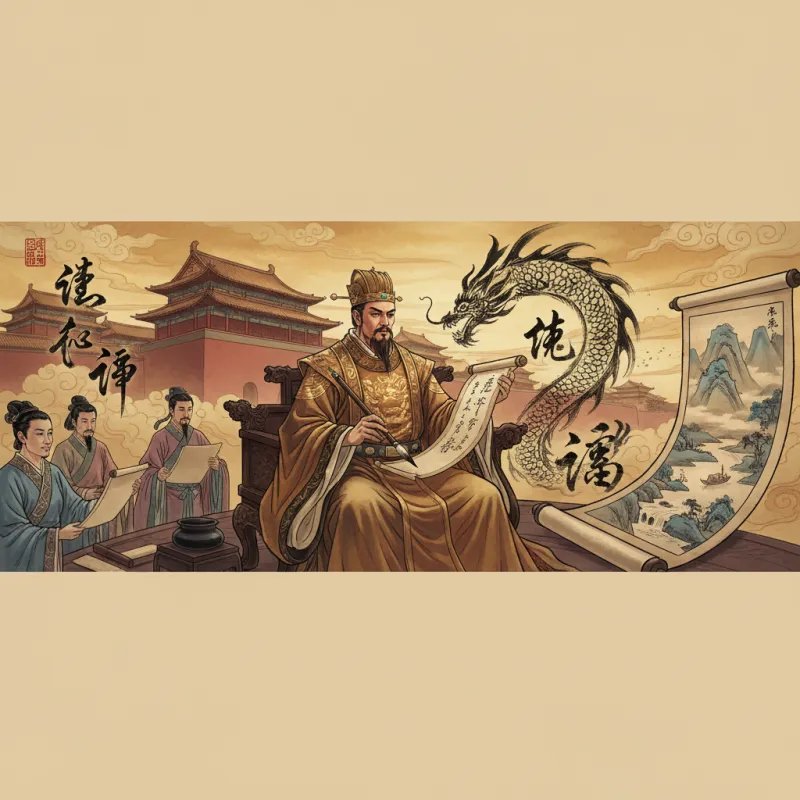
A single brushstroke can reveal whether you're anxious, drunk, or enlightened. In China, this isn't mysticism — it's calligraphy criticism. When the Tang Dynasty emperor Taizong died in 649 CE, he was buried with original works by Wang Xizhi, the 4th-century calligrapher whose writing he'd spent decades collecting. Not gold. Not jade. Calligraphy. That's how seriously the Chinese took handwriting.
The Elevation of Writing to Supreme Art
In most civilizations, writing serves speech — it's a recording technology. But in China, 书法 (shūfǎ, literally "the method of writing") became the highest art form, outranking painting, music, and sculpture. This wasn't arbitrary. Chinese characters aren't phonetic symbols; they're visual-semantic units that evolved from pictographs. Each character is a composition, a small architecture of strokes that must balance, flow, and breathe. Writing them well requires the same skills as painting — control of the brush, understanding of negative space, sense of rhythm — but with the added constraint of recognizability. You can't just make beautiful marks; they must remain legible characters.
The result? A literati culture where your handwriting was your face. An official's calligraphy on a memorial to the throne mattered as much as the content. A scholar's inscription on a painting could make or break its value. The Song Dynasty poet-official Su Shi (1037-1101) was as famous for his calligraphy as his poetry, and collectors paid fortunes for his casual notes. This wasn't about penmanship in the Western sense — neat, uniform letters. It was about capturing 气韵 (qìyùn), "spirit resonance," the vital energy that flows through all great art.
The Four Treasures and Their Alchemy
Chinese calligraphy depends on the 文房四宝 (wénfáng sìbǎo) — the "Four Treasures of the Study": brush (笔 bǐ), ink (墨 mò), paper (纸 zhǐ), and inkstone (砚 yàn). Each element matters profoundly. The brush, typically made from animal hair (rabbit, goat, weasel, or wolf), must be both flexible and responsive. Unlike a pen, which has a fixed width, a brush can produce lines from hair-thin to thumb-thick depending on pressure and angle. This variability is the medium's glory and terror.
Ink comes as a solid stick, ground fresh on the inkstone with water before each session. The grinding itself is meditative preparation, and the ink's consistency — watery or thick, fresh or aged — affects every stroke. Paper, invented in China during the Han Dynasty, must be absorbent enough to take ink beautifully but not so porous that it bleeds. The best paper, like 宣纸 (xuānzhǐ) from Anhui province, has been made using the same methods for over a thousand years.
These materials create a unique challenge: every stroke is permanent and unrepeatable. You can't erase. You can't go back and thicken a line. The brush hits the paper, the ink flows, and what happens in that instant is final. This immediacy means calligraphy captures the calligrapher's state of mind with brutal honesty. Hesitation shows. Confidence shows. The great calligrapher Zhang Xu (658-747) was famous for writing while drunk, his characters wild and barely legible but pulsing with energy. His "crazy cursive" (狂草 kuángcǎo) style influenced Chinese painting aesthetics for centuries.
The Five Major Scripts
Chinese calligraphy evolved through five major script styles, each with distinct aesthetics and historical contexts. 篆书 (zhuànshū), seal script, is the most ancient, used on bronze vessels and official seals during the Zhou and Qin dynasties. Its characters are pictographic, almost geometric, with a archaic dignity. 隶书 (lìshū), clerical script, emerged during the Han Dynasty as a more practical form for bureaucratic documents. It's flatter, wider, with distinctive "silkworm head and wild goose tail" strokes.
楷书 (kǎishū), regular script, is what most people learn first — the "printed" form of Chinese characters, clear and structured. It became standardized during the Tang Dynasty, and the calligrapher Yan Zhenqing (709-785) perfected a powerful, masculine version that's still studied today. 行书 (xíngshū), running script, is semi-cursive — faster than regular script but still legible. It's the everyday writing of educated people, balancing efficiency with beauty. Wang Xizhi's "Preface to the Orchid Pavilion" (353 CE), written in running script, is considered the greatest piece of calligraphy ever created. The original is lost, but copies and rubbings have been treasured for 1,700 years.
草书 (cǎoshū), cursive script, is the most abstract and expressive. Characters blur together, strokes abbreviate radically, and only trained eyes can read it. But at its best, cursive calligraphy achieves what Chinese aesthetics values most: spontaneity that reveals years of discipline, wildness that emerges from perfect control. It's jazz improvisation, but with a brush.
The Calligrapher's Training
Learning calligraphy means copying masters. For centuries, students traced and copied works by Wang Xizhi, Yan Zhenqing, Su Shi, and other canonical calligraphers. This isn't mindless imitation — it's embodied learning. By reproducing a master's strokes thousands of times, you internalize their rhythm, their pressure, their breathing. You learn how they thought through their hands.
The basic strokes — horizontal, vertical, dot, hook, sweep — seem simple but contain infinite subtlety. A horizontal stroke isn't just a line from left to right. It begins with the brush entering the paper at an angle, pressing down, moving right while maintaining even pressure, then lifting with a slight upward flick. The speed, the pressure, the angle all vary depending on the character, the position within the character, and the calligrapher's interpretation. Master these fundamentals, and you can write any of the 50,000+ Chinese characters. But mastering them takes decades.
The great calligraphers often came to the art late or practiced it alongside other pursuits. Wang Xizhi was a government official. Yan Zhenqing was a general who died defending a city against rebels. Su Shi was a poet, painter, and statesman exiled multiple times for political reasons. Their calligraphy reflected their full lives — not just technical skill but depth of experience, philosophical understanding, emotional range. This is why Chinese calligraphy resists pure formalism. It's not about perfect technique; it's about technique in service of expression, discipline enabling freedom.
Calligraphy and Character
The Chinese believed calligraphy revealed character — literally. The way you wrote showed who you were. Aggressive strokes suggested an aggressive personality. Timid strokes suggested weakness. Balanced, harmonious characters indicated a balanced, harmonious mind. This wasn't pseudoscience to them; it was observation. Since calligraphy requires such complete focus and such immediate execution, it bypasses conscious control. Your true self appears on the paper.
This belief had real consequences. During imperial examinations, candidates' calligraphy was scrutinized as carefully as their essays. Poor handwriting could cost you a government position, regardless of your knowledge. Conversely, beautiful calligraphy could advance your career. The Ming Dynasty had calligraphy specialists who did nothing but write imperial edicts in perfect regular script. Their job was to make the emperor's words look as authoritative as possible.
The connection between calligraphy and character also meant that owning someone's calligraphy was intimate. You possessed not just their writing but something of their spirit. This is why calligraphy became the most personal gift in Chinese culture, more meaningful than any manufactured object. When friends parted, they exchanged calligraphy. When scholars admired each other, they requested samples of writing. The scholar-official culture of imperial China ran on calligraphy as much as on Confucian texts.
The Western Disconnect
Western culture has nothing quite like Chinese calligraphy. Medieval illuminated manuscripts come closest — beautiful writing as art — but they were rare, specialized, created by monks in scriptoriums. They weren't part of every educated person's life. Arabic calligraphy shares some similarities, especially the religious significance and the emphasis on flowing, abstract beauty. But Chinese calligraphy's integration into daily life, its status as the supreme art form, its use as a measure of character — these are distinctive.
Part of the difference is linguistic. Alphabetic writing systems have 26-30 letters; Chinese has thousands of characters. Each character is a unique composition, which makes writing them inherently more complex and more visual. But the deeper difference is philosophical. Chinese culture never separated art from life the way Western culture did after the Renaissance. There was no "fine art" category distinct from craft or daily practice. Calligraphy was art, but it was also how you wrote letters, signed documents, and took notes. The greatest masterpieces were often casual writings — a poem dashed off after drinking, a note to a friend, a diary entry.
The Modern Fate
Calligraphy's status declined in the 20th century. The May Fourth Movement of 1919 attacked traditional culture, including calligraphy, as feudal and backward. The Communist revolution continued this rejection. Simplified characters, introduced in the 1950s to improve literacy, reduced the visual complexity that made calligraphy interesting. Computers and smartphones have made handwriting increasingly rare. Most young Chinese can type characters faster than they can write them, and many struggle to remember how to write complex characters by hand.
Yet calligraphy persists. It's taught in schools, practiced by hobbyists, and valued by collectors. Contemporary artists like Xu Bing and Gu Wenda have used calligraphy in conceptual works that question language, meaning, and cultural identity. Calligraphy remains the most expensive category of Chinese art at auction — a single work by Wang Xizhi, if one surfaced, would sell for hundreds of millions of dollars.
The persistence makes sense. Calligraphy embodies something central to Chinese civilization: the belief that how you do something matters as much as what you do. That beauty and meaning are inseparable. That discipline and spontaneity aren't opposites but partners. These ideas, encoded in brushstrokes for three thousand years, don't disappear just because people type on phones. They're too fundamental, too deeply woven into how Chinese culture understands art, language, and human expression. As long as anyone picks up a brush and writes a character, trying to capture not just its form but its spirit, calligraphy lives.
Related Reading
- Chinese Painting: Mountains, Mist, and Empty Space
- Chinese Opera: A Thousand Years of Drama
- Chinese Art and Calligraphy: The Four Arts Every Scholar Had to Master
- Chinese Architecture: Forbidden Cities, Pagodas, and Garden Design
- The Four Great Inventions: How China Changed the World
- Ancient Chinese Law: When Justice Was Personal and Punishment Was Public
- The Legacy of Chinese Emperors: Dynasties, Power, and Cultural Influence