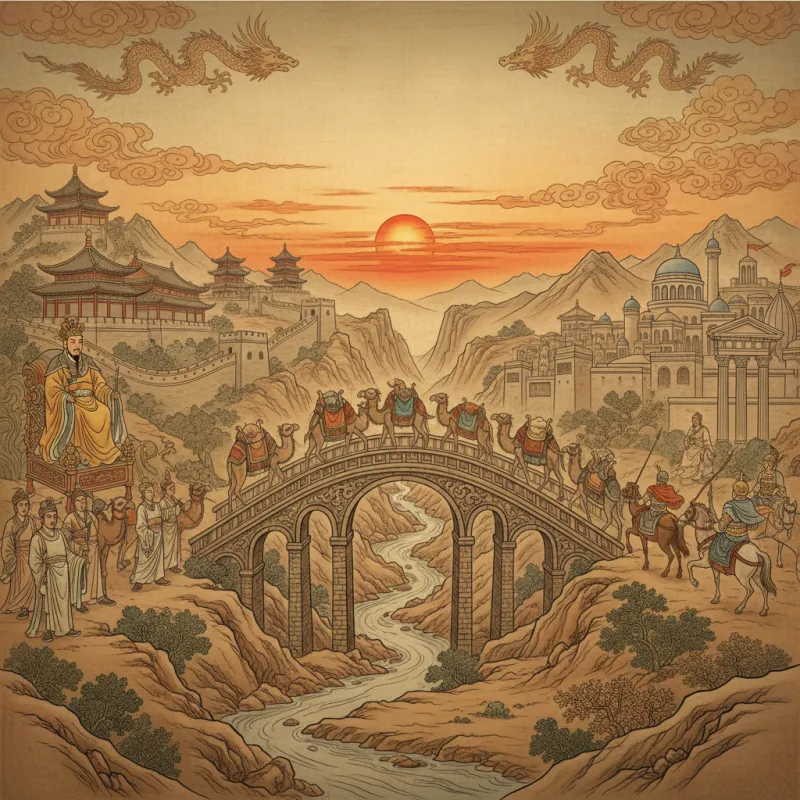
A single bolt of silk could buy a horse in Samarkand, a slave in Rome, or safe passage through the Taklamakan Desert. For over a millennium, this shimmering fabric—so light it could pass through a ring, so strong it could stop an arrow—became the currency that bound continents together. But the Silk Road was never really about silk. It was about everything humans could dream, create, or believe, flowing like water through the arteries of the ancient world.
The Han Dynasty Opens the Gate to the West
The Silk Road didn't emerge from careful planning or diplomatic treaties. It was born from desperation and ambition. In 138 BCE, Emperor Wu of Han (汉武帝, Hàn Wǔdì) dispatched Zhang Qian (张骞, Zhāng Qiān), a palace official, on what should have been a straightforward diplomatic mission to forge an alliance with the Yuezhi people against the Xiongnu nomads who terrorized China's northern borders. Zhang Qian was captured almost immediately and spent ten years as a prisoner before escaping, completing his mission, and returning thirteen years after his departure with only one companion from his original party of one hundred.
His mission was a diplomatic failure—the Yuezhi had no interest in fighting the Xiongnu. But Zhang Qian brought back something far more valuable: detailed intelligence about the "Western Regions" (西域, Xīyù), including Ferghana's legendary "heavenly horses" that sweated blood, the sophisticated irrigation systems of Sogdiana, and tantalizing reports of even more distant lands. Emperor Wu, recognizing the strategic and economic potential, launched military campaigns to secure the Hexi Corridor and establish the four commanderies that would become the gateway to Central Asia. By 119 BCE, Chinese silk was flowing westward in exchange for horses, jade, and exotic goods that Han aristocrats had never imagined.
The Mechanics of Exchange: How Trade Actually Worked
Contrary to romantic notions of merchants traveling from Chang'an (长安, Cháng'ān, modern Xi'an) all the way to Rome, the Silk Road functioned more like a relay race. Goods passed through dozens of middlemen, each controlling a segment of the route. Sogdian merchants—the Iranians who dominated Central Asian trade—were the true masters of this system. They established trading colonies from Dunhuang to Samarkand, learned multiple languages, and developed sophisticated credit systems that allowed goods to move without the physical transfer of currency.
A typical transaction might see Chinese silk leave Chang'an in the hands of a merchant who would sell it in Dunhuang. A Sogdian trader would purchase it there, transport it to Samarkand, and sell it to a Parthian merchant, who would carry it to Ctesiphon. From there, Syrian traders might take it to Antioch, and finally, Roman merchants would bring it to the markets of Rome—where it sold for its weight in gold. Each middleman added their markup, which explains why silk cost exponentially more in Rome than in China. The Roman historian Pliny the Elder complained bitterly about the drain of Roman gold to the East, estimating that 100 million sesterces flowed annually to India and China for luxuries.
This system also meant that direct knowledge between Rome and China remained remarkably limited. The Romans called China "Serica" (the land of silk) and believed silk grew on trees. The Chinese knew Rome as "Da Qin" (大秦, Dà Qín, "Great Qin") and imagined it as a mirror civilization in the far west. The first recorded Roman embassy to China didn't arrive until 166 CE, during the reign of Emperor Huan of Han, and even then, it probably consisted of enterprising merchants rather than official envoys.
The Spiritual Highway: Buddhism's Journey East
If silk was the Silk Road's most famous export, Buddhism was its most transformative import. The dharma traveled the same routes as merchants, carried by monks who endured the same hardships and dangers. The earliest Buddhist missionaries arrived in China during the first century CE, but the religion truly took root during the period of disunity following the Han Dynasty's collapse. When political chaos shattered Confucian certainty, Buddhism offered answers to questions about suffering and salvation that traditional Chinese philosophy hadn't adequately addressed.
The translation of Buddhist texts became one of history's great intellectual projects. Monks like Kumarajiva (鸠摩罗什, Jiūmóluóshí, 344-413 CE), who was kidnapped from Kucha and brought to Chang'an, spent decades rendering Sanskrit concepts into Chinese. This wasn't simple translation—it required inventing new vocabulary and philosophical frameworks. Terms like "nirvana" became "涅槃" (nièpán), while "karma" became "业" (yè). The process transformed both Buddhism and Chinese thought, creating distinctly Chinese schools like Chan (禅, Chán, later Zen in Japan) that synthesized Buddhist meditation with Daoist naturalism.
The most famous pilgrim was Xuanzang (玄奘, Xuánzàng, 602-664 CE), whose seventeen-year journey to India and back inspired the classic novel "Journey to the West." Unlike the fictional version with its monkey king and demons, the real Xuanzang's journey was even more remarkable—he traveled illegally (the Tang court had forbidden travel to the Western Regions), crossed the Taklamakan Desert alone after his guide abandoned him, studied at Nalanda University in India, and returned with 657 Buddhist texts. His detailed travel accounts remain invaluable historical sources for understanding seventh-century Central Asia and India. The impact of Buddhism on Chinese culture cannot be overstated—it influenced everything from art and architecture to funeral practices and vegetarian cuisine.
The Oasis Cities: Cosmopolitan Jewels of the Desert
The Silk Road's most fascinating aspect wasn't its endpoints but its middle—the oasis cities that dotted the routes around the Taklamakan Desert. Cities like Dunhuang (敦煌, Dūnhuáng), Turfan (吐鲁番, Tǔlǔfān), Kashgar (喀什, Kāshí), and Samarkand became cosmopolitan melting pots where Chinese, Indian, Persian, and eventually Arab cultures collided and merged.
Dunhuang's Mogao Caves (莫高窟, Mògāo Kū) preserve this cultural synthesis in stunning detail. The 492 caves contain thousands of Buddhist murals and sculptures spanning a millennium, showing the evolution of artistic styles as Indian, Central Asian, and Chinese influences blended. In 1900, a Daoist monk discovered the "Library Cave" sealed since the 11th century, containing over 50,000 manuscripts in Chinese, Tibetan, Sanskrit, Sogdian, and other languages—one of the greatest archaeological finds in history. These documents revealed not just religious texts but contracts, letters, music scores, and even a printed copy of the Diamond Sutra from 868 CE, the world's oldest dated printed book.
These cities operated under a pragmatic multiculturalism born of economic necessity. Zoroastrians, Buddhists, Nestorian Christians, Manichaeans, and later Muslims lived side by side, each community contributing to the city's prosperity. The Sogdians, in particular, seemed to collect religions like merchants collect goods—Sogdian documents show individuals with Buddhist, Zoroastrian, and Manichaean names in the same family. This wasn't syncretism so much as practical tolerance: when your livelihood depends on trade with diverse peoples, religious exclusivity becomes a luxury you can't afford.
The Tang Dynasty: The Silk Road's Golden Age
The Silk Road reached its apex during the Tang Dynasty (618-907 CE), when China's power extended deep into Central Asia and Chang'an became the world's largest and most cosmopolitan city, with over one million residents. The Tang capital hosted communities of Persian, Arab, Indian, and Central Asian merchants, each with their own quarters, temples, and customs. Tang emperors employed foreign generals, married foreign princesses, and patronized foreign religions. Emperor Taizong's favorite general, Li Shiji, was of Turkic origin, while the catastrophic An Lushan Rebellion (755-763 CE) was led by a general of Sogdian and Turkic descent.
This cosmopolitanism permeated Tang culture. The era's most celebrated poets, including Li Bai (李白, Lǐ Bái), wrote verses about Western Regions' exotic goods and peoples. Tang ladies adopted Central Asian fashions, wearing revealing clothing and riding horses astride rather than sidesaddle—behavior that would have scandalized earlier dynasties. The Tang court's fascination with foreign culture extended to music and dance; the "Western Liang music" and "Sogdian whirl" became court favorites. Archaeological evidence shows Tang aristocrats were buried with figurines of foreign merchants, musicians, and even African servants, reflecting the diversity of their world.
The Tang also saw the arrival of new technologies and goods from the West. The Chinese invention of paper had already begun spreading westward, but the Tang period saw the introduction of new crops like grapes, pomegranates, and walnuts, which became so integrated into Chinese cuisine that many people today don't realize their foreign origins. Glass-making techniques from the Mediterranean influenced Chinese craftsmen, while Chinese porcelain began its journey westward, eventually giving China its English name.
The Decline and Legacy
The Silk Road's decline was gradual and multifaceted. The An Lushan Rebellion devastated Tang power in Central Asia, allowing Tibetan and Uighur forces to fill the vacuum. The rise of Islam transformed the cultural landscape of Central Asia, though it didn't immediately disrupt trade. The real death blow came from maritime routes. By the Song Dynasty (960-1279 CE), sea trade via the South China Sea and Indian Ocean offered a faster, cheaper, and safer alternative to the overland routes. The Mongol conquests of the 13th century briefly revived the Silk Road—the Pax Mongolica made overland travel safer than it had been in centuries—but this proved temporary. When the Ming Dynasty (1368-1644 CE) turned inward and the Ottoman Empire disrupted traditional routes, the Silk Road's era definitively ended.
Yet its legacy endures in unexpected ways. The genetic diversity of modern Central Asian populations reflects centuries of mixing. Linguistic borrowings traveled both directions—Chinese words entered Persian and Arabic, while Chinese absorbed terms from Sanskrit and Persian. The very concept of a connected world, where goods and ideas flow across vast distances, was normalized by the Silk Road's existence. When we speak today of globalization, we're describing a process that began when that first bolt of silk left Chang'an for the unknown West, carrying with it not just fabric, but the possibility of connection across seemingly unbridgeable divides.
The Silk Road reminds us that isolation has never been humanity's natural state. For all our modern anxieties about cultural exchange and foreign influence, our ancestors embraced the exotic with enthusiasm, adopting foreign religions, fashions, and foods with remarkable speed. The merchants, monks, and adventurers who traversed those dangerous routes weren't motivated by abstract ideals of cultural exchange—they wanted profit, salvation, or adventure. But in pursuing their individual goals, they wove together a world that, for all its differences, recognized a common humanity in the simple act of trade.
Related Reading
- The Imperial Examination: Meritocracy in Ancient China
- Confucius: Teachings That Shaped a Civilization
- The Four Great Inventions: Paper, Printing, Gunpowder, and the Compass
- The Real Mulan: History, Legend, and the Disney Version
- The Chinese Diaspora: How Chinese Culture Spread Worldwide