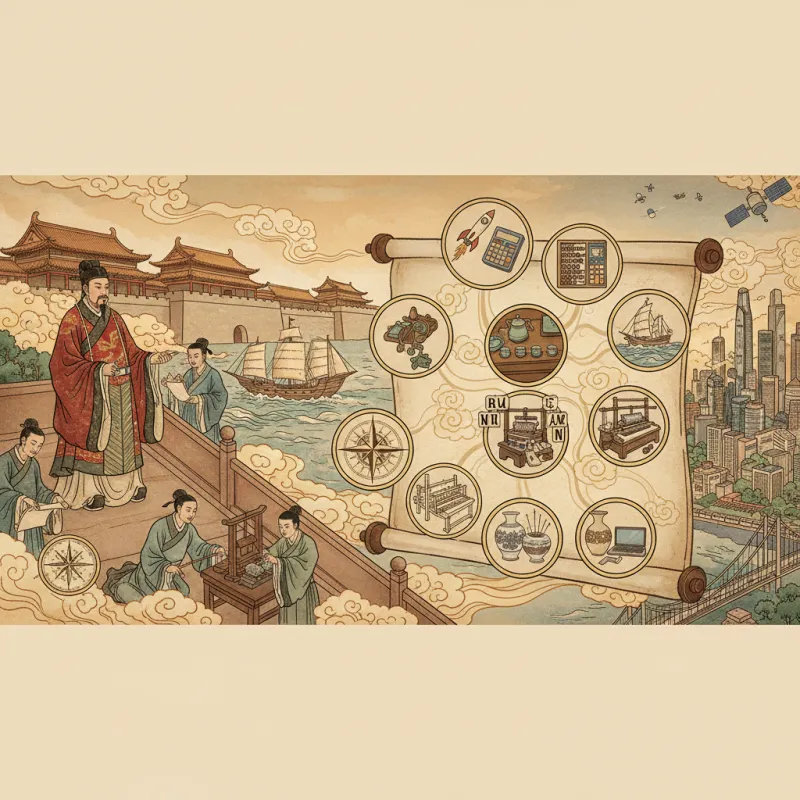
You probably used at least five Chinese inventions before breakfast this morning. That paper towel you grabbed? Chinese. The printed label on your coffee bag? Chinese printing technology. The compass chip in your phone's GPS? Based on a Chinese discovery. The porcelain mug you're drinking from? The word itself comes from China. Even the bureaucratic system that ensures your tap water is safe traces back to imperial China's civil service exams.
We walk through a world shaped by Chinese innovation, yet most of us never pause to notice. The fingerprints of ancient China are everywhere — in our pockets, on our desks, in our kitchens, embedded so deeply into modern life that they've become invisible. Here are ten ways the dynasties of imperial China fundamentally rewired human civilization.
Paper: The Medium That Changed Everything
Around 105 CE, a court eunuch named Cai Lun (蔡伦) presented Emperor He of Han with something revolutionary: a writing surface made from tree bark, hemp, old rags, and fishnets, pounded into pulp and dried into sheets. Before Cai Lun's innovation, the Chinese wrote on heavy bamboo strips or expensive silk. His paper — 纸 (zhǐ) — was cheap, lightweight, and could be mass-produced.
The impact was seismic. Within centuries, paper enabled the explosion of Chinese literature, philosophy, and bureaucratic record-keeping that would define the Tang and Song dynasties. By the 8th century, paper had reached the Islamic world through captured Chinese papermakers after the Battle of Talas. From there it spread to Europe, arriving in Spain by the 12th century.
Without paper, there's no printing revolution, no widespread literacy, no scientific journals, no modern bureaucracy. Every book you've ever held, every document you've signed, every notebook you've scribbled in — all descendants of Cai Lun's mulched rags. The information age began in a Han dynasty workshop.
Printing: Democratizing Knowledge
The Chinese didn't just invent paper — they figured out how to mass-produce text on it. During the Tang dynasty (618-907 CE), woodblock printing emerged, allowing Buddhist sutras and Confucian classics to be reproduced by the thousands. The oldest surviving printed book is the Diamond Sutra from 868 CE, a scroll over 16 feet long with remarkably crisp characters.
But the real breakthrough came during the Song dynasty when Bi Sheng (毕昇) invented movable type around 1040 CE — four centuries before Gutenberg. Bi Sheng carved individual characters from clay, arranged them in an iron frame, printed the page, then rearranged the characters for the next page. Later innovations used wooden and metal type.
Why didn't Chinese printing trigger the same revolution as Gutenberg's? Partly because Chinese has thousands of characters versus a 26-letter alphabet, making movable type less efficient. But Chinese printing still transformed East Asian culture, enabling the spread of Confucian philosophy and creating the world's first true reading public centuries before Europe.
Gunpowder: The End of Knights and Castles
Taoist alchemists searching for an elixir of immortality in the 9th century instead discovered 火药 (huǒyào) — "fire medicine" — a mixture of saltpeter, sulfur, and charcoal that exploded when ignited. The irony is perfect: seeking eternal life, they created history's most efficient killing tool.
By the 10th century, the Song dynasty was using gunpowder in warfare — first in flamethrowers and grenades, then in primitive cannons and rockets. The Mongols, after conquering China, carried gunpowder weapons westward, introducing them to the Islamic world and Europe by the 13th century.
Gunpowder didn't just change how wars were fought — it demolished the entire feudal social order. Medieval castles became obsolete. Armored knights on horseback couldn't withstand cannon fire. Suddenly, a peasant with a musket could kill a nobleman who'd trained for combat since childhood. The military aristocracy that had dominated Europe for centuries crumbled, paving the way for centralized nation-states and eventually modern democracy.
The Compass: Opening the Oceans
Chinese fortune-tellers during the Han dynasty noticed that lodestone — naturally magnetized iron ore — always pointed the same direction. By the Song dynasty, they'd refined this into the 指南针 (zhǐnánzhēn) — "south-pointing needle" — initially used for feng shui and divination.
Then someone had a brilliant idea: put it on a ship. By the 11th century, Chinese sailors were using magnetic compasses for navigation, allowing them to venture far from coastlines even in cloudy weather. The technology reached Europe by the 12th century, probably through Arab intermediaries.
The compass made the Age of Exploration possible. Without it, Columbus never reaches America, Magellan never circumnavigates the globe, and European colonialism takes a very different shape. Every GPS device in every smartphone today is a direct descendant of that Song dynasty navigator's compass, still pointing north after a thousand years.
Porcelain: The White Gold
When Marco Polo returned from China in 1295, he brought tales of a mysterious white ceramic so fine you could see light through it. Europeans called it "porcellana" after the cowrie shell it resembled. They'd never seen anything like it — their own pottery was thick, crude, and porous by comparison.
Chinese potters had been perfecting 瓷器 (cíqì) since the Tang dynasty, firing kaolin clay at temperatures exceeding 1,200°C to create a material that was waterproof, durable, and translucent. The exact formula remained a Chinese secret for centuries. European alchemists spent fortunes trying to replicate it, finally succeeding in Germany in 1708.
For centuries, Chinese porcelain was one of the world's most valuable commodities, shipped along the Silk Road and later by sea to Europe, where aristocrats paid fortunes for a single vase. The global porcelain trade helped fuel China's economy and spread Chinese aesthetic influence worldwide. Today, "china" is still synonymous with fine dinnerware.
The Civil Service Exam: Meritocracy's Blueprint
In 605 CE, the Sui dynasty instituted the 科举 (kējǔ) — civil service examinations — to select government officials based on merit rather than birth. For over 1,300 years, any man (unfortunately, only men) could theoretically rise from peasant to prime minister by mastering the Confucian classics and passing a series of grueling exams.
The system wasn't perfect — it favored the wealthy who could afford years of study, and it ossified around rote memorization of ancient texts. But it was revolutionary. For the first time in history, a major civilization ran on brainpower rather than bloodlines. The 科举 created a literate bureaucratic class that administered China's vast empire with remarkable efficiency.
When European diplomats encountered this system in the 17th and 18th centuries, they were stunned. The idea influenced civil service reforms in Britain, France, and eventually the United States. Modern competitive exams for government positions — from the British Civil Service to the U.S. Foreign Service — all trace back to the Tang dynasty examination halls where nervous scholars spent three days locked in tiny cells, writing essays on Confucian virtue.
Silk: The Fabric That Connected Continents
For millennia, the Chinese guarded the secret of 丝绸 (sīchóu) — silk — so jealously that revealing the process was punishable by death. The technique of harvesting thread from silkworm cocoons, developed during the Neolithic period, gave China a monopoly on the world's most luxurious fabric.
Silk became the ultimate status symbol across Eurasia. Roman senators wore silk togas despite laws against the extravagance. The demand was so intense that it created the Silk Road, a 4,000-mile network of trade routes connecting China to the Mediterranean. Along these routes traveled not just silk, but ideas, religions, technologies, and diseases that reshaped civilizations.
The Silk Road facilitated the spread of Buddhism from India to China, introduced Chinese innovations to the West, and created the first truly global economy. When you hear about ancient trade routes shaping world history, you're really talking about the insatiable appetite for Chinese silk.
Tea: The Beverage That Built Empires
Legend says Emperor Shen Nong discovered 茶 (chá) in 2737 BCE when tea leaves accidentally blew into his boiling water. Whether or not that's true, tea cultivation was well-established by the Tang dynasty, when the scholar Lu Yu wrote the Cha Jing (茶经) — The Classic of Tea — codifying tea culture.
Tea became China's second-most valuable export after silk. By the 17th century, European demand for tea was so intense that it created massive trade imbalances. Britain's solution? Smuggle opium into China to balance the books, leading to the Opium Wars and the collapse of the Qing dynasty.
Tea shaped global history in countless ways. The Boston Tea Party sparked the American Revolution. British tea plantations in India and Ceylon were built to break China's monopoly. Tea breaks became embedded in British culture. Today, tea is the world's second-most consumed beverage after water, and every cup connects back to those Tang dynasty tea gardens.
Noodles: The Original Fast Food
The Chinese were eating 面条 (miàntiáo) — noodles — at least 4,000 years ago, as evidenced by a perfectly preserved bowl of millet noodles discovered in northwestern China in 2005. From China, noodle-making spread along trade routes to Central Asia, the Middle East, and eventually Italy.
Yes, Marco Polo probably didn't introduce pasta to Italy — Italians were already eating it. But the technique almost certainly originated in China and traveled westward over centuries. Today, noodles are a global staple, from Japanese ramen to Italian spaghetti to Vietnamese pho, all variations on a Chinese innovation.
The genius of noodles is their versatility and preservation. Dried noodles could be stored for months, making them ideal for travelers and armies. They could be adapted to local ingredients and tastes. They were cheap, filling, and fast to prepare. In many ways, noodles were the original convenience food, and they remain one of humanity's most popular meals.
Acupuncture: Ancient Medicine Meets Modern Science
For over 2,000 years, practitioners of 针灸 (zhēnjiǔ) — acupuncture — have been inserting thin needles into specific points on the body to treat pain and illness. The practice is based on traditional Chinese medicine's concept of qi (气) — life energy — flowing through meridians in the body.
Western medicine long dismissed acupuncture as superstition. But modern research has found that acupuncture genuinely relieves certain types of pain, possibly by triggering the release of endorphins or affecting nerve pathways. The World Health Organization now recognizes acupuncture as effective for dozens of conditions.
Today, acupuncture is practiced worldwide, covered by many insurance plans, and studied in major medical journals. Whether or not you accept the traditional explanation of qi and meridians, the empirical fact remains: a technique developed in ancient China continues to provide relief to millions of patients in the 21st century.
The Invisible Foundation
Walk through any modern city and you're walking through a landscape shaped by Chinese innovation. The paper in the office printer, the compass in your navigation app, the porcelain in the bathroom, the tea in the break room, the noodles at lunch, the bureaucracy that keeps the city running — all Chinese.
Ancient China's greatest trick was making its influence invisible. These innovations became so fundamental to human civilization that we forgot where they came from. We don't think of paper as "Chinese" any more than we think of the wheel as "Mesopotamian" — they're just part of the fabric of modern life.
But every time you print a document, check your GPS, or sip tea, you're participating in traditions that stretch back to the Han, Tang, and Song dynasties. The modern world isn't just influenced by ancient China — in many ways, it's built on a Chinese foundation.
Related Reading
- The Chinese Diaspora: How Chinese Culture Spread Worldwide
- The Cultural Revolution: What Actually Happened
- How the Opium Wars Still Shape China Today
- How to Learn Chinese History: A Beginner's Roadmap
- Liu Bei vs. Cao Cao: The Ultimate Rivalry in Chinese History
- Diplomacy and Cultural Exchange in Chinese Ancient Dynasties
- The Silk Road: Bridge Between East and West