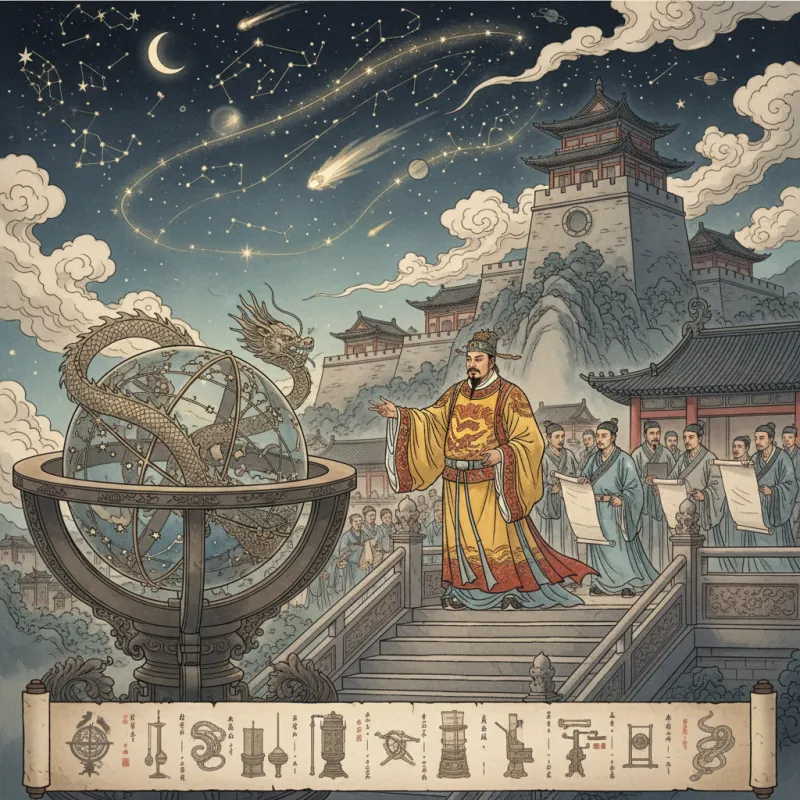
When a "guest star" blazed into view on July 4, 1054 CE, Chinese astronomers at the Song Dynasty court meticulously recorded its position, brightness, and duration in the night sky. This supernova — which created what we now call the Crab Nebula — was so bright it could be seen during daylight for 23 days. While Chinese records documented it in exquisite detail, European chronicles remained silent. This wasn't an isolated incident. For over four millennia, Chinese astronomers maintained the most comprehensive celestial record in human history, tracking comets, eclipses, and stellar phenomena with a precision that modern astrophysicists still consult today.
Oracle Bones and the Shang Sky
Chinese astronomical observation begins not with philosophers pondering the cosmos, but with diviners cracking turtle shells. During the Shang Dynasty (商朝 Shāng Cháo, c. 1600–1046 BCE), oracle bone inscriptions reveal that court astronomers were already tracking lunar phases, solar eclipses, and the movements of Venus. These weren't abstract scientific pursuits — the Shang kings needed to know when to plant, when to wage war, and when the heavens approved of their rule.
The oracle bones contain references to eclipses that modern astronomers have verified occurred exactly when the inscriptions claim. One bone fragment records a solar eclipse on June 5, 1302 BCE, making it one of the earliest precisely dated astronomical events in human history. The Shang weren't just watching the sky; they were building a database.
What's striking is the purpose behind this observation. Unlike the Greeks who would later seek geometric perfection in planetary orbits, Shang astronomers served the state. The king's legitimacy depended on maintaining harmony between heaven and earth. An unexpected eclipse could signal divine displeasure, threatening the entire political order. This fusion of astronomy and statecraft would define Chinese celestial observation for the next three thousand years.
The Zhou Revolution: Heaven's Mandate in the Stars
When the Zhou Dynasty (周朝 Zhōu Cháo, 1046–256 BCE) overthrew the Shang, they needed cosmic justification. Enter the concept of the Mandate of Heaven (天命 tiānmìng) — the idea that celestial phenomena reflected the moral fitness of rulers. This wasn't mere superstition; it transformed Chinese astronomy into a sophisticated bureaucratic enterprise.
Zhou astronomers developed the earliest Chinese star catalogs, dividing the sky into 28 lunar mansions (二十八宿 èrshíbā xiù) that tracked the moon's monthly journey. Each mansion corresponded to a specific region of the empire, creating a celestial map that mirrored earthly geography. When Mars lingered in the mansion associated with the capital, court astrologers interpreted it as a warning about internal rebellion.
The Zhou also established the position of Grand Astrologer (太史 tàishǐ), a court official who combined the roles of astronomer, historian, and political advisor. This wasn't a ceremonial post — the Grand Astrologer wielded genuine power, as their interpretations of celestial events could make or break political careers. The famous historian Sima Qian (司馬遷 Sīmǎ Qiān) held this position during the Han Dynasty, demonstrating how astronomy, history, and statecraft remained inseparable.
Han Dynasty Precision: The First Star Catalog
The Han Dynasty (漢朝 Hàn Cháo, 206 BCE–220 CE) represents the golden age of early Chinese astronomy. In 104 BCE, Emperor Wu commissioned the Taichu Calendar (太初曆 Tàichū Lì), which calculated the solar year at 365.25016 days — remarkably close to the modern value of 365.2422 days. This wasn't achieved through telescopes or advanced mathematics, but through centuries of patient observation and record-keeping.
Around 100 BCE, the astronomer Sima Qian's father, Sima Tan, compiled a star catalog listing 1,464 stars organized into 283 asterisms. This predated Ptolemy's Almagest by over two centuries. The Han astronomers didn't just count stars; they tracked their positions with enough precision that modern researchers use their records to study stellar proper motion over two millennia.
Han astronomers also documented comets with obsessive detail. The appearance of Halley's Comet in 12 BCE was recorded with descriptions of its tail length, color, and trajectory. Chinese records contain 31 appearances of Halley's Comet dating back to 240 BCE, providing an unbroken observational record that Western astronomy cannot match. When Edmund Halley calculated his comet's orbit in 1705, he relied partly on Chinese historical records to verify its periodicity.
The Han also made the first recorded observation of sunspots in 28 BCE, nearly 1,600 years before Galileo's telescopic observations. The astronomer Gan De (甘德 Gān Dé) may have even observed Jupiter's moons with the naked eye around 364 BCE, though this claim remains debated. What's undeniable is that Han astronomers were pushing the limits of unaided human observation.
Tang and Song: The Age of Mechanical Heavens
The Tang Dynasty (唐朝 Táng Cháo, 618–907 CE) and Song Dynasty (宋朝 Sòng Cháo, 960–1279 CE) saw Chinese astronomy reach new heights of sophistication, both observational and mechanical. In 724 CE, the Buddhist monk and astronomer Yi Xing (一行 Yī Xíng) led an ambitious project to measure the length of the meridian arc. His team set up observation posts across the empire, from Mongolia to Vietnam, measuring the sun's shadow at summer solstice. This was the first large-scale geodetic survey in history, predating similar European efforts by a thousand years.
Yi Xing also designed an elaborate water-powered armillary sphere that automatically tracked celestial positions. But the true masterpiece came in 1088 CE, when the polymath Su Song (蘇頌 Sū Sòng) completed his astronomical clock tower in Kaifeng. Standing over 30 feet tall, this mechanical marvel combined an armillary sphere, a celestial globe, and a clock mechanism driven by a sophisticated escapement — the same principle that would power European mechanical clocks centuries later.
Su Song's clock wasn't just impressive engineering; it represented a philosophical shift. By mechanizing the heavens, Song astronomers were asserting that celestial motions followed predictable, mechanical laws. This was a radical idea that paralleled developments in Chinese mathematics and would influence later astronomical thinking.
The Song Dynasty also witnessed the supernova of 1054 CE mentioned earlier, but it wasn't the only one. Chinese records document supernovae in 185 CE, 393 CE, 1006 CE, 1054 CE, and 1181 CE. Modern astronomers have identified the remnants of several of these explosions, confirming the accuracy of Chinese observations. The 1006 supernova was described as bright enough to cast shadows at night — the brightest stellar event in recorded history.
The Jesuit Encounter: When Two Astronomies Collided
When Jesuit missionaries arrived in China during the late Ming Dynasty (明朝 Míng Cháo, 1368–1644 CE), they brought European astronomical knowledge, including Copernican heliocentrism and Galileo's telescopic discoveries. The encounter was less a clash than a negotiation between two sophisticated astronomical traditions.
Matteo Ricci (利瑪竇 Lì Mǎdòu) arrived in 1582 and quickly realized that Chinese astronomy, while different in approach, was formidable in its precision. The Jesuits' advantage lay in their geometric models and predictive accuracy for planetary positions. In 1629, when both Chinese and European astronomers were asked to predict an eclipse, the Jesuit calculations proved more accurate, earning them positions at the Imperial Astronomical Bureau.
But the Jesuits didn't simply replace Chinese astronomy. Instead, a synthesis emerged. Chinese astronomers adopted European instruments like the telescope and sextant while maintaining their traditional observational methods and calendrical systems. The Qing Dynasty (清朝 Qīng Cháo, 1644–1912 CE) astronomical bureau became a hybrid institution where Chinese and European methods coexisted, each compensating for the other's weaknesses.
This wasn't cultural capitulation; it was pragmatic adaptation. Chinese astronomers recognized that European geometric models offered better planetary predictions, while their own tradition excelled at long-term record-keeping and calendrical calculations. The result was a uniquely Chinese form of early modern astronomy that borrowed selectively from European science while maintaining its own institutional identity.
The Legacy: Why Chinese Astronomy Still Matters
Modern astrophysicists regularly consult Chinese historical records. When studying stellar evolution, supernovae, or cometary orbits, the continuous Chinese observational record provides data unavailable anywhere else. The supernova of 185 CE, recorded in the Book of Later Han, helped astronomers identify the pulsar RCW 86. Chinese records of solar eclipses have been used to calculate the gradual slowing of Earth's rotation over millennia.
But the legacy goes beyond data. Chinese astronomy represents an alternative path for understanding the cosmos — one that prioritized empirical observation over theoretical models, calendrical precision over geometric elegance, and practical utility over abstract truth. While Greek astronomy asked "what are the true motions of the planets?", Chinese astronomy asked "when will the next eclipse occur?" Both questions are valid; they simply reflect different priorities.
The institutional structure of Chinese astronomy also offers lessons. By making celestial observation a state function, Chinese dynasties ensured continuous funding and record-keeping across political upheavals. The Imperial Astronomical Bureau survived dynasty changes, invasions, and civil wars, maintaining observational continuity that no European institution could match. This wasn't accidental — it was the result of a political system that saw astronomical accuracy as essential to legitimate rule.
Perhaps most importantly, Chinese astronomy reminds us that science isn't culturally neutral. The questions we ask, the methods we use, and the purposes we serve are shaped by our social context. Chinese astronomers weren't inferior to their Greek counterparts; they were solving different problems with different tools. Their four-thousand-year record stands as testament to what patient observation, institutional support, and practical focus can achieve — even without telescopes, calculus, or Newtonian mechanics.
When you look up at the Crab Nebula through a modern telescope, you're seeing the remnant of that "guest star" from 1054 CE. Chinese astronomers saw it first, recorded it faithfully, and preserved that knowledge for a millennium. That's not just history — it's a gift to every astronomer who came after.
Related Reading
- Traditional Chinese Medicine: 2,500 Years of Healing
- The Four Great Inventions: Paper, Printing, Gunpowder, and the Compass
- Chinese Astronomy: Mapping the Stars for 4000 Years
- Chinese Science and Technology: Inventions That Changed the World (Before Europe Noticed)
- How to Learn Chinese History: A Beginner's Roadmap
- Unraveling the Economic Tapestry of Ancient Chinese Dynasties
- Delving into Ancient China: A Journey Through Dynasties, Emperors, and Cultural Treasures