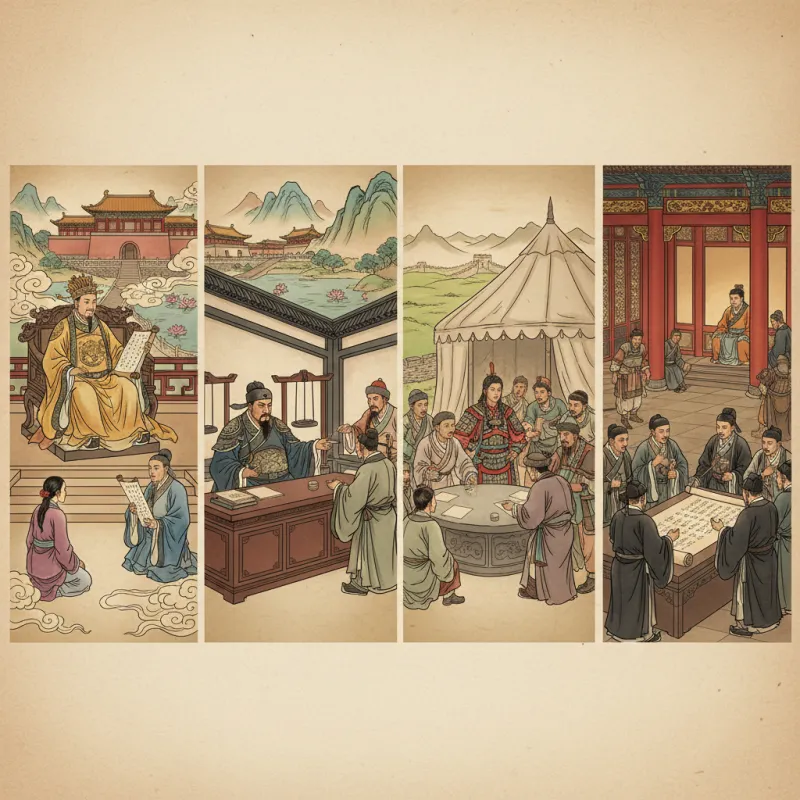
A young widow stands before a magistrate, falsely accused of poisoning her father-in-law. She knows she'll be convicted — the evidence has been fabricated, the witnesses bribed, and the judge is either incompetent or corrupt. In her final moments, she makes three predictions: her blood will fly upward and stain a white banner, snow will fall in midsummer, and drought will plague the region for three years. All three come true. This is the story of Dou E (窦娥, Dòu É), and while it's a work of fiction, it captures something brutally real about Chinese legal history: the system's awareness of its own fallibility, and the desperate need for mechanisms to correct judicial errors.
Chinese law didn't evolve through philosophical treatises alone. It evolved through cases — specific injustices that exposed flaws so glaring they couldn't be ignored. Some of these trials are historical fact, documented in official records. Others exist in that murky space between legend and reality, their details embellished but their legal impact undeniable. What matters isn't always whether the case actually happened exactly as recorded, but whether it changed how people thought about justice.
The Dou E Case: When Literature Becomes Legal Precedent
The play "The Injustice to Dou E" (窦娥冤, Dòu É Yuān) was written by Guan Hanqing (关汉卿) during the Yuan dynasty, probably in the 1290s. It's a revenge tragedy, but it's also a searing critique of judicial corruption. The plot is straightforward: Dou E, a young widow, is framed for murder by a local thug who wants to force her into marriage. The magistrate tortures her, and to spare her elderly mother-in-law from torture, Dou E confesses to a crime she didn't commit.
Here's what makes this case legally significant: it became the template for discussing wrongful convictions in Chinese legal culture. The play was so popular, so widely performed, that "Dou E's injustice" (窦娥冤) became shorthand for any case where an innocent person was convicted. Legal scholars referenced it. Magistrates knew it. It created cultural pressure for appeals processes and case reviews.
The Yuan dynasty legal code was notoriously harsh, influenced by Mongol military law. Torture was routine. Confessions were king. The Dou E story didn't change the law overnight, but it planted an idea: what if the system is wrong? What if the confession was coerced? By the Ming dynasty, legal reformers were citing cases like Dou E's (even though it was fictional) to argue for mandatory case reviews in capital punishment cases. The imperial legal system eventually incorporated multiple levels of review precisely because stories like Dou E's made the alternative morally untenable.
Yang Naiwu and Xiao Baicai: The Case That Shook the Qing
Period: 1873-1877, Qing dynasty
Crime: Alleged murder and adultery
Outcome: Wrongful conviction overturned after four years, massive purge of corrupt officials
If Dou E is legendary, Yang Naiwu (杨乃武) and Xiao Baicai (小白菜, "Little Cabbage") are historical — and their case nearly brought down the Qing legal system.
In 1873, a man named Ge Pinlian died suddenly in Yuhang County, Zhejiang Province. Local officials accused his young wife, Bi Xiu'gu (nicknamed Xiao Baicai), of poisoning him with the help of her alleged lover, Yang Naiwu, a local scholar. Both were arrested, tortured, and convicted. Yang was sentenced to death by strangulation.
But Yang's sister refused to accept the verdict. She traveled to Beijing and threw herself in front of the imperial carriage, demanding a retrial. This triggered a cascade of reviews that eventually reached the Empress Dowager Cixi herself. When investigators exhumed Ge Pinlian's body four years after his death, they found no evidence of poisoning. The original magistrate had fabricated evidence, tortured witnesses, and ignored basic forensic procedures.
The fallout was spectacular. Over a hundred officials were dismissed, demoted, or punished. The case exposed systemic corruption in the provincial examination system (Yang was a xiucai scholar, and his conviction was partly motivated by jealousy from less successful officials). More importantly, it led to reforms in how capital cases were reviewed. The Qing court mandated that all death penalty cases must be reviewed by the Board of Punishments (刑部, Xíng Bù) in Beijing, not just approved by provincial governors.
This case matters because it demonstrated that even in a declining dynasty, public pressure and persistent advocacy could force the system to correct itself. The Yang Naiwu case became a rallying point for legal reformers who argued that China needed codified criminal procedures, not just the discretion of individual magistrates.
The She Xianglin Case: Modern China's Dou E
Period: 1994-2005
Crime: Alleged murder of his wife
Outcome: Wrongful conviction, served 11 years before "victim" returned alive
Fast forward to 1994. She Xianglin (佘祥林), a security guard in Hubei Province, was accused of murdering his wife after she disappeared. Police found a decomposed female body in a nearby reservoir and decided it was her. She Xianglin was tortured for ten days until he confessed. He was convicted and sentenced to death, later commuted to 15 years.
In 2005, his "dead" wife walked back into town. She'd run away with another man and had been living in Shandong Province the entire time.
The She Xianglin case became a watershed moment for legal reform in modern China. It exposed the continued use of torture to extract confessions, the lack of proper forensic standards, and the absence of effective defense counsel. The case sparked nationwide debate about wrongful convictions and directly contributed to several reforms:
- In 2012, China amended its Criminal Procedure Law to explicitly prohibit forced confessions and require that evidence obtained through torture be excluded
- The Supreme People's Court reclaimed the power to review all death penalty cases (it had delegated this to provincial courts in 1983)
- Legal aid programs expanded to ensure defendants in serious criminal cases have access to lawyers
The parallels to Dou E are striking. Both cases involved coerced confessions. Both exposed judicial corruption and incompetence. Both became cultural touchstones that forced the legal system to confront its failures. The difference is that She Xianglin lived to see his vindication, while Dou E's justice came only in the supernatural realm.
The Nie Shubin Case: Justice Delayed 21 Years
Period: 1995-2016
Crime: Rape and murder
Outcome: Executed in 1995, exonerated in 2016 after another man confessed
Nie Shubin (聂树斌) was 21 years old when he was arrested in 1994 for the rape and murder of a woman in Hebei Province. He was convicted based on a confession (likely coerced) and executed by firing squad in 1995. The entire process — arrest to execution — took less than a year.
In 2005, a man named Wang Shujin, already in prison for other crimes, confessed to the murder for which Nie had been executed. Nie's parents spent the next decade fighting for their son's exoneration. In 2016, the Supreme People's Court finally overturned the conviction, declaring Nie innocent.
This case is significant for several reasons. First, it demonstrated that even execution doesn't end a case if there's evidence of wrongful conviction. Second, it showed the power of persistent family advocacy — Nie's mother became a symbol of parental devotion and legal injustice. Third, it accelerated reforms in death penalty procedures.
The Nie Shubin case contributed to a dramatic reduction in executions in China. While exact numbers are state secrets, legal scholars estimate that annual executions dropped from thousands in the 1990s to hundreds (or fewer) by the 2010s. The Supreme People's Court's reclamation of death penalty review authority, partly motivated by cases like Nie's, created a bottleneck that slowed the execution pipeline and forced lower courts to be more careful.
The Zhao Zuohai Case: Another "Dead" Victim Returns
Period: 1999-2010
Crime: Alleged murder
Outcome: Served 11 years before "victim" returned alive
In 1999, Zhao Zuohai (赵作海) was convicted of murdering a man whose body was found in a village well. Like She Xianglin, Zhao was tortured into confessing. Like She Xianglin, he served over a decade in prison. And like She Xianglin, his "victim" turned out to be alive — the body in the well was someone else entirely.
When the "murdered" man returned to the village in 2010, Zhao was released and compensated. But the case raised uncomfortable questions: How many other wrongful convictions are there? How many "victims" won't conveniently return to prove innocence?
The Zhao Zuohai case, coming just five years after She Xianglin's exoneration, created a sense of crisis in Chinese legal circles. Two nearly identical cases in a decade suggested systemic problems, not isolated errors. It reinforced calls for the reforms that would be codified in the 2012 Criminal Procedure Law amendments.
The Huugjilt Case: Executed at 18, Exonerated at 39
Period: 1996-2014
Crime: Rape and murder
Outcome: Executed in 1996, exonerated in 2014 after serial killer confessed
Huugjilt (呼格吉勒图), an 18-year-old Mongolian teenager, was arrested in 1996 for the rape and murder of a woman in a public restroom in Hohhot, Inner Mongolia. He was convicted and executed 61 days after the crime — one of the fastest death penalty cases on record.
In 2005, a serial rapist and murderer named Zhao Zhihong confessed to the crime for which Huugjilt had been executed. It took another nine years for the courts to officially exonerate Huugjilt. His parents received compensation and an apology, but their son was long dead.
The Huugjilt case is particularly significant because it exposed the dangers of rushed justice. The 61-day timeline from crime to execution left no room for investigation, defense, or review. It was a conveyor belt to the execution ground. The case became a rallying point for abolishing the "strike hard" (严打, yándǎ) campaigns that prioritized speed and severity over accuracy.
The criminal justice reforms that followed these cases represent a fundamental shift in Chinese legal philosophy: from prioritizing social order and swift punishment to recognizing that wrongful convictions undermine the system's legitimacy more than any individual crime could.
What These Cases Teach Us
These trials — from the legendary Dou E to the modern wrongful convictions — share common threads. They expose the dangers of torture-induced confessions, the corruption of local officials, the inadequacy of forensic standards, and the absence of effective defense counsel. They also demonstrate something more hopeful: the system's capacity for self-correction when public pressure and persistent advocacy force it to confront its failures.
Chinese legal history isn't a story of steady progress. It's a story of crisis and response, of injustices so egregious they couldn't be ignored, of families who refused to accept verdicts even when the state insisted the case was closed. The development of Chinese law has always been driven by these concrete cases, not abstract principles.
The modern wrongful conviction cases — She Xianglin, Nie Shubin, Zhao Zuohai, Huugjilt — occurred during a period when China was supposedly modernizing its legal system. They revealed that new laws on paper don't automatically translate to justice in practice. But they also showed that publicity, advocacy, and institutional pressure can force change even in an authoritarian system.
Dou E's blood flew upward to stain the white banner. In the real cases, the "blood" was the public outrage that forced reforms. The supernatural elements of the Yuan dynasty play have been replaced by media coverage, legal advocacy, and Supreme Court reviews. But the underlying dynamic remains the same: injustice exposed, system forced to respond, law changed to prevent recurrence.
These aren't just famous trials. They're the cases that made the Chinese legal system confront its own capacity for error and cruelty. They're the reason China now has mandatory death penalty reviews, exclusionary rules for coerced confessions, and expanded legal aid. They're proof that even in a system that values stability over individual rights, specific cases can force specific reforms.
The question isn't whether the Chinese legal system is perfect — it obviously isn't. The question is whether it can learn from its mistakes. These cases suggest it can, slowly and painfully, one wrongful conviction at a time.
Related Reading
- Ancient Chinese Law: When Justice Was Personal and Punishment Was Public
- Crime and Punishment in Imperial China
- The Magistrate System: How Justice Worked
- Legalism: The Philosophy That Built an Empire
- Diplomacy and Cultural Exchange in Chinese Ancient Dynasties
- What Ordinary People Ate in Ancient China (It Was Not What You Think)
- The Art of War Is Not About War (It Is About Avoiding It)