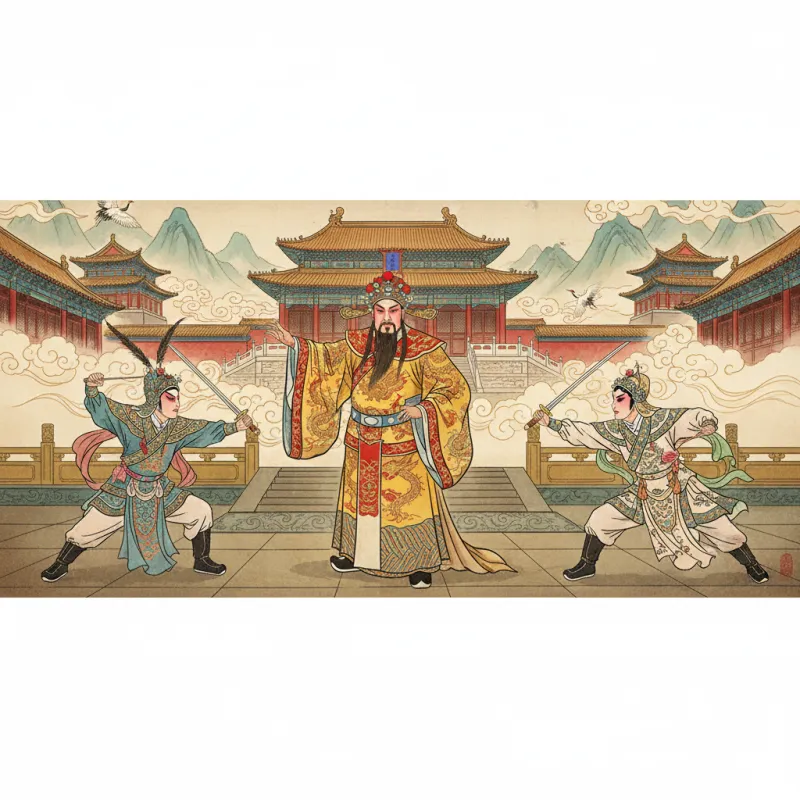
The stage explodes in crimson and gold. A warrior enters with a back-flip, his face painted in swirling patterns of red and black, pheasant feathers trembling from his headdress. He hasn't spoken a word, but you already know everything: his rank, his temperament, his fate. This is Chinese opera — where a single sleeve gesture can convey a thousand words, where walking in a circle means crossing mountains, and where the color on an actor's face tells you whether to trust him with your life.
The Birth of Drama in the Tang Court
Chinese opera didn't spring fully formed from the earth. Its roots stretch back to the Tang Dynasty (618-907 CE), when Emperor Xuanzong established the Pear Garden (梨园, líyuán) — the first known theatrical training academy in Chinese history. The emperor himself was obsessed with performance, personally training hundreds of musicians and actors. When we call performers "disciples of the pear garden" today, we're invoking this 1,300-year-old tradition.
But Tang court entertainment was just the seed. The real flowering came during the Song Dynasty (960-1279 CE), when zaju (杂剧, zájù) — variety plays mixing music, dance, and comedy — became wildly popular in urban entertainment districts. These weren't refined court performances. They were rowdy, commercial, performed in teahouses and marketplaces for merchants and laborers who wanted spectacle and story. The plots were simple: corrupt officials exposed, lovers reunited, ghosts seeking revenge. The appeal was universal.
The Yuan Dynasty (1271-1368 CE) transformed these variety shows into something more sophisticated. Under Mongol rule, many educated Chinese scholars found themselves barred from government service. Some turned to playwriting. The result was Yuan zaju — four-act plays with complex plots, poetic arias, and social commentary sharp enough to draw blood. Guan Hanqing's "The Injustice to Dou E" (窦娥冤, Dòu É Yuān) told the story of a young widow falsely executed, whose ghost returns to prove her innocence. It's still performed today, and its critique of judicial corruption still lands.
The Four Great Classical Forms
By the Qing Dynasty (1644-1912 CE), regional opera styles had proliferated across China like wildflowers. But four forms rose to dominance, each with its own aesthetic, musical system, and geographic base.
Kunqu (昆曲, kūnqǔ), born in Jiangsu province during the Ming Dynasty, is the aristocrat of Chinese opera. Its singing style is refined, almost whispered, with elaborate ornamentation. The movements are slow, graceful, impossibly controlled. Kunqu was the opera of scholars and officials, performed in private gardens for audiences who could appreciate its literary sophistication. "The Peony Pavilion" (牡丹亭, Mǔdān Tíng) by Tang Xianzu is Kunqu's masterpiece — a 55-scene epic about a young woman who dies of lovesickness, returns as a ghost, and is eventually resurrected. It takes three full days to perform in its entirety.
Peking Opera (京剧, jīngjù) is the form most foreigners encounter first. It emerged in Beijing in the late 18th century, synthesizing elements from several regional styles. Compared to Kunqu, Peking Opera is louder, faster, more acrobatic. The singing is that distinctive high-pitched style that sounds so alien to Western ears — it's meant to cut through the noise of a crowded theater without amplification. The painted faces (脸谱, liǎnpǔ) are Peking Opera's calling card: red for loyalty, white for treachery, black for integrity, gold for gods and demons.
Yueju (越剧, yuèjù), from Zhejiang province, is the gentle counterpoint to Peking Opera's bombast. Its melodies are soft, lyrical, almost conversational. And here's the twist: all roles, male and female, are traditionally performed by women. This creates a fascinating aesthetic — female actors playing male scholars with a delicacy and romanticism that male actors rarely achieve. "The Butterfly Lovers" (梁山伯与祝英台, Liáng Shānbó yǔ Zhù Yīngtái), China's Romeo and Juliet story, finds its most heartbreaking expression in Yueju.
Chuanju (川剧, chuānjù), from Sichuan province, is the wild card. It's famous for face-changing (变脸, biànliǎn) — a technique where actors switch masks in the blink of an eye, sometimes cycling through a dozen faces in seconds. The method is a closely guarded secret, passed down through master-apprentice lineages. Chuanju also incorporates fire-breathing, rolling lights on the head, and other spectacular tricks. It's opera as magic show, and it's utterly thrilling.
The Language of Gesture and Symbol
Western theater aims for realism. Chinese opera aims for something else — a heightened, symbolic reality where everything means more than itself. This is why understanding Chinese opera requires learning its visual vocabulary.
Take the riding crop. When an actor enters holding a horsewhip and mimes mounting, you're meant to understand he's on horseback. When he walks in a circle, he's traveling great distances. When he dismounts, he simply stops walking and hands the crop to an attendant. No actual horse required. The convention is so established that Chinese audiences don't even think about it — they see the journey, not the walking.
Water sleeves (水袖, shuǐxiù) — those impossibly long white silk extensions attached to costume sleeves — are the opera's most expressive tool. A flick can express joy, anger, or disdain. A slow wave suggests longing. A sharp snap indicates decision. Skilled actors can make the sleeves seem alive, like extensions of their emotional state. The water-sleeve dance in "The Drunken Concubine" (贵妃醉酒, Guìfēi Zuìjiǔ) is a masterclass in this technique — the concubine's intoxication and disappointment expressed entirely through silk.
The painted faces deserve their own encyclopedia. Each color, each pattern carries meaning. Red faces indicate loyalty and courage — Guan Yu, the deified general from the Three Kingdoms period, always appears in red. White faces signal cunning and treachery — Cao Cao, Guan Yu's rival, wears white. Black faces show integrity and fierceness. Blue and green indicate rebellious or supernatural characters. The patterns themselves tell stories: a butterfly on the forehead might indicate a character's connection to transformation, while specific line patterns can denote rank or personality traits.
The Four Role Types
Chinese opera doesn't cast actors by their natural appearance. It casts them by role type (行当, hángdang), and these types are as rigid as they are ancient.
Sheng (生) are male roles, subdivided into old men (laosheng), young scholars (xiaosheng), and martial men (wusheng). Each subtype has its own movement vocabulary, vocal style, and costume conventions. Old men sing in a deep, resonant voice and move with dignified restraint. Young scholars sing in a higher register and move with romantic grace. Martial men barely sing at all — they're too busy doing backflips and stage combat.
Dan (旦) are female roles, also subdivided: virtuous women (qingyi), vivacious young women (huadan), warrior women (daomadan), and old women (laodan). The qingyi is the opera's emotional center — she sings the most beautiful arias, performs the most delicate dances, and usually suffers the most tragic fate. The huadan is lighter, more playful, often a maid or young wife. The daomadan gets to do all the acrobatics, wielding swords and spears with the same skill as male warriors.
Jing (净), the painted-face roles, are larger-than-life characters: generals, bandits, gods, demons. They sing in a powerful, rough voice and move with exaggerated swagger. These are the roles that require the most physical presence — actors are often chosen for their height and build.
Chou (丑), the clown roles, are the opera's truth-tellers. They wear a distinctive white patch around their nose and eyes, and they're the only characters allowed to break the fourth wall, comment on the action, and make jokes about current events. In a highly stylized art form, the chou provides spontaneity and connection to everyday life. They're also often the most technically skilled performers — clowning requires perfect timing and the ability to improvise.
The Cultural Revolution and Near-Death
Chinese opera almost died in the 20th century. The Cultural Revolution (1966-1976) was particularly devastating. Traditional opera was denounced as feudal poison. Theaters were closed. Actors were persecuted. Costumes and scripts were burned. For a decade, the only permitted performances were the eight "model operas" (样板戏, yàngbǎn xì) — revolutionary works with titles like "The Red Detachment of Women" and "Taking Tiger Mountain by Strategy."
These model operas are fascinating artifacts. They used traditional opera techniques — the painted faces, the stylized movement, the symbolic gestures — but applied them to revolutionary content. Landlords wore white faces like traditional villains. Communist heroes wore red like traditional loyal generals. The water-sleeve dance was repurposed to express revolutionary fervor instead of romantic longing. It was propaganda, but it was also proof that the opera form itself was flexible enough to survive radical transformation.
When the Cultural Revolution ended, traditional opera slowly revived. But it faced new challenges. Young people, exposed to film, television, and Western pop culture, found traditional opera boring and incomprehensible. Theaters struggled to fill seats. Master performers aged without finding worthy successors. By the 1990s, Chinese opera seemed destined to become a museum piece, preserved but not truly alive.
The Modern Revival
Something unexpected happened in the 21st century. Chinese opera started coming back, not as a relic but as a living art form. The revival has taken several forms, some controversial, all interesting.
Experimental productions have updated traditional stories with modern staging, lighting, and even electronic music. A 2008 production of "The Peony Pavilion" used video projections and contemporary dance alongside traditional Kunqu singing. Purists were horrified. Younger audiences were intrigued. The production sold out.
Cross-cultural collaborations have introduced Chinese opera techniques to Western audiences. The Metropolitan Opera in New York commissioned "The First Emperor," a Peking Opera-influenced work with music by Tan Dun. It wasn't entirely successful artistically, but it demonstrated that opera's symbolic language could translate across cultures.
Most importantly, Chinese opera has found new life online. Short video platforms like Douyin (Chinese TikTok) are filled with young performers demonstrating face-changing techniques, water-sleeve dances, and painted-face makeup tutorials. These clips get millions of views. Some young performers have become internet celebrities, making traditional opera cool again through sheer skill and charisma.
The government has helped, designating Kunqu and Peking Opera as UNESCO Intangible Cultural Heritage and funding training programs. But the real revival is grassroots — young people discovering that this ancient art form is actually spectacular, demanding, and unlike anything else in the world.
Why Opera Still Matters
Chinese opera endures because it does something that realistic theater cannot: it makes the invisible visible. When an actor flicks his sleeve in anger, you don't just see anger — you see the precise quality and intensity of that anger, distilled and amplified through centuries of refinement. When a warrior does a backflip, you're not watching athletics — you're watching courage made physical.
This is why opera can tell stories that would seem melodramatic in realistic theater. When the ghost of Dou E returns to prove her innocence, causing snow to fall in summer and drought to last three years, the supernatural elements don't seem absurd. They seem right. The stylization of the form makes room for the mythic, the symbolic, the emotionally true even when it's factually impossible.
Chinese opera also preserves something increasingly rare: a complete aesthetic system, where every element — music, movement, costume, makeup, gesture — works together according to centuries-old principles. In an age of fragmentation and constant innovation, there's something powerful about an art form that says: these are the rules, they've worked for a thousand years, and within these constraints we'll create infinite variation.
The painted faces still tell you who to trust. The water sleeves still express what words cannot. The riding crop still carries you across mountains. And if you stop trying to understand it intellectually and just watch — really watch — it still clicks. Not despite its strangeness, but because of it.
Related Reading
- Chinese Architecture: Forbidden Cities, Pagodas, and Garden Design
- Chinese Calligraphy: The Art of Writing as High Culture
- Chinese Painting: Mountains, Mist, and Empty Space
- Chinese Art and Calligraphy: The Four Arts Every Scholar Had to Master
- Chinese Astronomy: Mapping the Stars for 4000 Years
- The Role of Trade in Shaping Ancient Chinese Dynasties and Culture
- Famous Trials That Changed Chinese Law