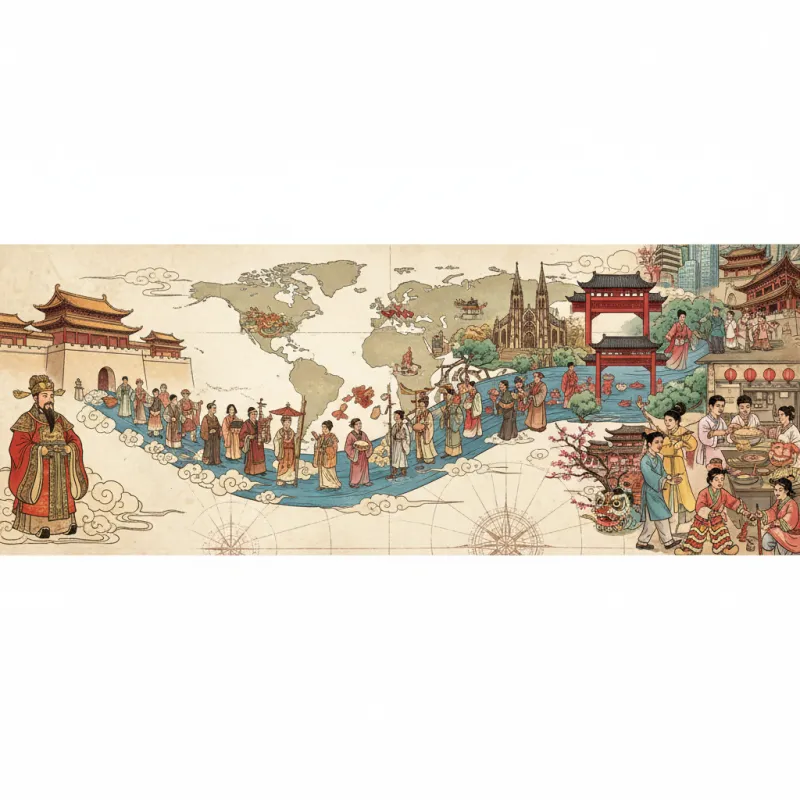
When Zheng He's treasure fleet sailed into Malacca in 1405, the locals weren't surprised to see Chinese faces. They'd been doing business with Chinese merchants for centuries. What shocked them was the scale — 300 ships, 28,000 men, vessels nine times larger than anything Columbus would command. But here's the thing: Zheng He's armada wasn't the beginning of Chinese global presence. It was just the most dramatic chapter in a story that had been unfolding quietly for a thousand years, and would explode into something far more complex in the centuries to come.
Today, over 50 million people of Chinese descent live outside mainland China. That's roughly the population of South Korea, scattered across every continent. But calling this a single "diaspora" (华侨 huáqiáo, literally "overseas Chinese") is like calling all Europeans "immigrants" — it flattens centuries of distinct migrations, each with its own character, its own reasons, its own relationship to the homeland.
The Silent Centuries: Early Southeast Asian Networks
Long before the word "Chinatown" existed, Chinese traders were establishing communities throughout Southeast Asia. During the Song Dynasty (宋朝 Sòng Cháo, 960–1279), merchants from Fujian and Guangdong provinces sailed south with porcelain, silk, and tea, returning with spices, tropical hardwoods, and exotic goods that Chinese elites craved. These weren't explorers or conquerors — they were businessmen who married local women, learned local languages, and created hybrid communities that would become the foundation of Southeast Asian Chinese culture.
The Ming Dynasty (明朝 Míng Cháo, 1368–1644) briefly flirted with imperial naval power through Zheng He's voyages, but after 1433, China turned inward. The government banned private overseas trade and even made emigration illegal. Didn't matter. Fujianese and Cantonese merchants kept sailing anyway, establishing what historians call the Nanyang (南洋 Nányáng, "Southern Ocean") trading network. By the time Europeans arrived in the 16th century, they found Chinese merchants already dominating commerce from Manila to Malacca to Batavia.
These early migrants created the Peranakan (峇峇娘惹 Bābā Niángre) culture in Malaysia and Singapore — Chinese who'd been there so long they'd developed their own language (a Malay-Hokkien hybrid), their own cuisine (nyonya food), their own identity distinct from both China and their host countries. This pattern would repeat itself everywhere Chinese migrants went: adaptation without complete assimilation, maintaining cultural threads while weaving new patterns.
The Coolie Trade: Migration Under Duress
Then came the 19th century, and everything changed. The Opium Wars, the Taiping Rebellion (太平天国 Tàipíng Tiānguó, 1850–1864), and general Qing Dynasty collapse created millions of desperate people. Western colonial powers and American railroad companies needed cheap labor. The result was the "coolie trade" — a system that shipped hundreds of thousands of Chinese workers to build railroads in America, work plantations in Cuba and Peru, mine gold in Australia and California.
Call it what it was: barely-disguised slavery. Men from Guangdong province signed contracts they couldn't read, promising years of labor for passage to "Gold Mountain" (金山 Jīnshān, the Chinese name for California). Many never made it home. Those who did brought back stories and money that would fuel the next wave of migration — this time voluntary, but still desperate.
The Chinese who built the western half of America's transcontinental railroad (1863–1869) worked in conditions that killed thousands. They were paid less than white workers, given the most dangerous jobs (like handling explosives), and lived in segregated camps. When the railroad was completed, the famous photograph of the golden spike ceremony included zero Chinese faces, despite Chinese workers comprising 90% of the Central Pacific workforce. That erasure tells you everything about how these migrants were viewed.
The Exclusion Era and Paper Sons
America's response to Chinese immigration was the Chinese Exclusion Act of 1882 — the first U.S. law to ban an entire ethnic group. Canada, Australia, and New Zealand followed with their own "White Australia" and "White Canada" policies. But Chinese kept coming, using a loophole: the 1906 San Francisco earthquake destroyed birth records, allowing Chinese men to claim U.S. citizenship and then "discover" sons back in China who could immigrate as citizens' children.
These "paper sons" (纸儿子 zhǐ érzi) memorized elaborate fake family histories during the weeks-long ship journey to America. Immigration officials at Angel Island (the West Coast's Ellis Island) interrogated them for hours, asking questions like "How many steps lead to your house?" and "Which direction does your village well face?" One wrong answer meant deportation. The coaching books these men studied, with their detailed village layouts and family trees, are now museum artifacts — evidence of the desperate creativity migration requires.
This created Chinese American communities that were overwhelmingly male, working-class, and trapped in ethnic enclaves. Without families, without the right to own property in many places, without access to most professions, they created parallel economies: laundries, restaurants, grocery stores serving their own communities. The "Chinatown" as Americans know it — cramped, exotic, slightly dangerous — was born from exclusion, not choice.
Post-1949: The Political Diaspora
When the Communist Party won China's civil war in 1949, a new type of migration began. Wealthy families, intellectuals, Nationalist Party members, and anyone who'd collaborated with the old regime fled to Hong Kong, Taiwan, and beyond. Unlike earlier economic migrants, many of these refugees were educated, urban, and politically connected. They brought capital, skills, and a fierce anti-Communist identity that would shape overseas Chinese communities for decades.
This wave created the Chinese communities of places like Flushing, New York, and Monterey Park, California — middle-class suburbs rather than urban Chinatowns. They established Chinese-language schools, cultural organizations, and business networks that connected the diaspora in new ways. The Chinese language and writing system became a marker of cultural identity, taught to children born abroad who might never visit China.
Meanwhile, Southeast Asian countries with large Chinese populations faced their own reckonings. Indonesia's anti-Chinese pogroms in 1965-1966 killed hundreds of thousands. Malaysia's affirmative action policies favored ethnic Malays over Chinese. Vietnam expelled its Chinese population after 1975. Each crisis sent new waves of refugees to Australia, North America, and Europe, diversifying the diaspora further.
The New Migration: Students and Entrepreneurs
China's economic opening after 1978 created yet another migration pattern. Starting in the 1980s, hundreds of thousands of Chinese students went abroad for education. Unlike earlier migrants, most planned to return. Many didn't. The 1989 Tiananmen Square massacre convinced many students to stay abroad, and the U.S. granted them permanent residency.
This "brain drain" became a "brain circulation" by the 2000s. Chinese professionals moved fluidly between China and the West, maintaining homes and businesses in both places. The term "sea turtle" (海归 hǎiguī, a pun on "returned from overseas") described returnees who brought Western education and business practices back to China. Silicon Valley became a hub for Chinese engineers and entrepreneurs, many of whom would later return to China to found companies like Baidu and Sina.
Today's Chinese diaspora includes billionaire tech founders, working-class restaurant owners, political dissidents, international students, and everyone in between. They speak different dialects, hold different passports, have different relationships to China. A fourth-generation Chinese Peruvian whose ancestors arrived in the 1870s has little in common with a Shanghai software engineer on an H-1B visa in Seattle, yet both get counted in that "50 million" figure.
Cultural Transmission and Transformation
What makes the Chinese diaspora culturally significant isn't just its size — it's how Chinese culture adapted and evolved in new contexts. Chinese New Year (春节 Chūnjié) is now an official holiday in Singapore, Malaysia, and several other countries. Dim sum (点心 diǎnxīn) has become global comfort food. Martial arts films from Hong Kong influenced Hollywood. Feng shui (风水 fēngshuǐ) consultants advise Western architects.
But this isn't one-way cultural export. Overseas Chinese created new cultural forms: Chinese-Jamaican patois, Chinese-Cuban cuisine, Chinese-Australian literature. Amy Tan writes about Chinese American identity in ways that would be incomprehensible to someone in Beijing. The Chinese festivals and celebrations practiced in San Francisco's Chinatown preserve traditions that have evolved differently in modern China.
The diaspora also preserved things that disappeared in China. Traditional characters (繁体字 fántǐzì) remain standard in Taiwan and Hong Kong, while the mainland uses simplified characters. Overseas Chinese temples maintained religious practices that were suppressed during the Cultural Revolution. Cantonese opera thrived in San Francisco while struggling in Guangzhou.
The Complicated Present
Today's Chinese diaspora faces new complexities. Rising China means overseas Chinese are viewed with suspicion in some Western countries — are they loyal to their adopted homes or to Beijing? The Chinese government's efforts to maintain influence over overseas Chinese communities through organizations like the United Front Work Department create genuine concerns about foreign interference.
Meanwhile, younger generations of overseas Chinese navigate multiple identities. They might speak English or Spanish as their first language, practice Buddhism or Christianity, marry outside their ethnicity, and have complicated feelings about a "homeland" they've never lived in. The influence of Confucianism on Chinese society might mean less to a third-generation Chinese Canadian than to their grandparents, yet they still face questions about where they're "really from."
The Chinese diaspora isn't a monolith, and it never was. It's a collection of distinct communities, created by different historical forces, maintaining different relationships to Chinese culture and to China itself. Some overseas Chinese visit China as tourists in a foreign country. Others maintain deep business and family ties. Some support the current Chinese government; others fled it. The only thing they all share is that somewhere in their family history, someone left China and created something new.
That's the real story of the Chinese diaspora — not the preservation of some pure Chinese culture abroad, but the creation of new hybrid cultures, new identities, new ways of being Chinese that China itself never imagined. From the Peranakan of Singapore to the Chinese-Peruvians of Lima to the Chinese-Canadians of Vancouver, the diaspora shows that culture isn't a fixed thing you carry with you. It's something you remake in every new place, every new generation, every new encounter with the world.
Related Reading
- How to Learn Chinese History: A Beginner's Roadmap
- The Cultural Revolution: What Actually Happened
- 10 Ways Ancient China Changed the Modern World
- How the Opium Wars Still Shape China Today
- The Imperial Examination: Meritocracy in Ancient China
- The Magistrate System: How Justice Worked
- Delving into Ancient China: A Journey Through Dynasties, Emperors, and Cultural Treasures