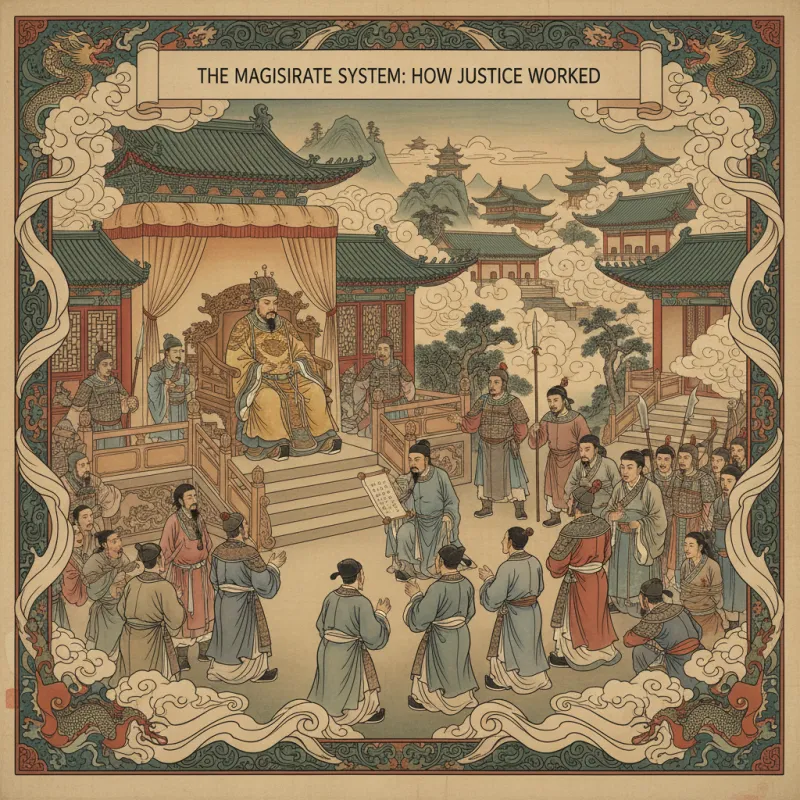
A farmer's wife stands before the county yamen, clutching a bloodied knife and weeping. Her husband lies dead in their home. The magistrate — a scholar who passed the imperial examinations by memorizing Confucian classics, not forensic science — must now determine whether this is murder, self-defense, or accident. He has no police force, no forensic lab, no jury. Just himself, a few clerks who may or may not be corrupt, and a legal code that prescribes specific punishments for hundreds of different crimes. Welcome to justice in imperial China.
The Loneliest Job in the Empire
The county magistrate (知县, zhī xiàn) occupied one of the most paradoxical positions in Chinese government. He wielded enormous power over tens of thousands of people, yet he worked in near-total isolation from other officials. He was called the "father and mother official" (父母官, fùmǔ guān) — expected to care for his people like a parent — but he was deliberately posted far from his home province to prevent favoritism and corruption.
Most magistrates governed counties they'd never seen before, speaking dialects they barely understood, enforcing customs they found alien. The Qing dynasty made this explicit policy: no official could serve in his home province or within 500 li (about 250 kilometers) of his birthplace. A magistrate from Fujian might find himself in Gansu. A southerner who'd never seen snow might govern a northern county where the Yellow River froze solid each winter.
And he did everything. Tax collection, criminal investigation, civil litigation, public works, ritual ceremonies, famine relief, bandit suppression, and maintaining the Confucian moral order. The magistrate was simultaneously judge, prosecutor, police chief, tax collector, public works director, and moral exemplar. If he failed at any of these roles, his career was over — or worse, his head might be.
The Yamen: Where Justice Happened
The county yamen (衙门, yámén) was part courthouse, part government office, part prison, and part residence. Its architecture reflected Confucian hierarchy: the main gate faced south (the direction of the emperor), the magistrate's court sat elevated above the common people, and the jail cells lurked in the back corners like a shameful secret.
When the magistrate held court, he sat behind a large desk draped with red cloth, wearing his official robes and hat. On the desk lay the tools of his trade: the vermillion brush for signing documents, the official seal that made his decisions law, and — most ominously — the torture implements. Yes, torture was legal and expected in Chinese criminal procedure. The bamboo rod, the finger press, the ankle press, and various other devices hung on the walls or lay ready at hand.
The court sessions were public theater. Anyone could attend. The magistrate would strike a wooden block (惊堂木, jīngtángmù) to call for order — that sharp crack echoing through the hall meant justice was about to be dispensed. Plaintiffs and defendants knelt before him on the stone floor. There were no lawyers. No right to remain silent. The magistrate asked questions, witnesses testified, and if the magistrate suspected someone was lying, he could order torture on the spot.
This sounds barbaric to modern ears, but it operated under strict rules. The Tang Code and later legal codes specified exactly which torture methods could be used, for how long, and under what circumstances. A magistrate who exceeded these limits could be punished himself. The system assumed that truth emerged through ordeal — a problematic assumption that led to countless false confessions.
The Magistrate's Impossible Workload
Consider the numbers. A typical county in the Qing dynasty contained 100,000 to 300,000 people. The magistrate had perhaps 20 to 40 clerks and runners to help him govern this population. That's one official per 5,000 to 15,000 people. For comparison, a modern American county of 100,000 people might have hundreds of government employees.
The magistrate's day began before dawn. He performed ritual sacrifices to Confucius and local deities. He reviewed tax records and correspondence from the provincial governor. He held court sessions that might last hours, hearing case after case. He inspected public works projects. He met with local gentry to discuss community affairs. He studied legal precedents and consulted the Qing Code (大清律例, Dà Qīng Lǜlì) to ensure his judgments were correct. He wrote reports to his superiors. He dealt with emergencies — fires, floods, famines, bandits.
And he did all this knowing that any mistake could destroy him. The Qing dynasty maintained elaborate systems of surveillance and accountability. Every three years, officials underwent performance reviews (考核, kǎohé). If a magistrate's county experienced rising crime, falling tax revenue, or social unrest, he received black marks. Too many black marks meant demotion or dismissal. Serious failures — like allowing a riot or losing tax money — could result in criminal prosecution.
The pressure was immense. Many magistrates suffered nervous breakdowns. Some turned to opium. Others became cynical and corrupt, extracting bribes to supplement their inadequate salaries. The honest ones — and there were many — worked themselves to exhaustion trying to serve both the emperor above and the people below.
The Clerks and Runners: The Real Power?
Here's the dirty secret of the magistrate system: the magistrate might be the official face of justice, but the clerks (书吏, shūlì) and runners (衙役, yáyì) often controlled what actually happened.
These men were locals, not outsiders. They knew the county intimately — every family, every feud, every secret. They knew which merchants were wealthy, which farmers were troublemakers, which gentry families held real power. The magistrate, posted from another province, knew none of this. He depended entirely on his staff to explain local conditions, translate dialects, and navigate social complexities.
This created opportunities for corruption that would make a modern lobbyist blush. Clerks could "lose" documents, delay cases, or subtly alter the facts they presented to the magistrate. Runners could extort money from people they arrested or investigated. Both groups operated informal fee systems — want your case heard quickly? Pay the clerk. Want the runner to go easy during your arrest? Pay him too.
The magistrate knew this happened but couldn't stop it. His salary was too low to hire honest staff, and he needed these men to function. The Qing government deliberately kept official salaries low, expecting magistrates to supplement their income through "customary fees" (陋规, lòuguī) — a euphemism for legalized corruption. The system was designed to be corrupt, then punished officials when corruption got out of hand. It was madness.
Some magistrates fought back. The famous Qing official Huang Liuhong wrote a handbook for magistrates that included detailed advice on controlling corrupt clerks and runners. His solution? Constant vigilance, surprise inspections, and cultivating informants among the staff. Essentially, the magistrate had to run a counterintelligence operation against his own employees.
Criminal Justice: Confession Was Everything
Chinese criminal procedure operated on a simple principle: no conviction without confession. Physical evidence, witness testimony, and circumstantial proof all mattered, but the case wasn't closed until the accused confessed.
This explains why torture was so central to the system. If a magistrate believed someone was guilty but they refused to confess, he was stuck. He couldn't convict without a confession, but he also couldn't let a guilty person go free. So he applied pressure — sometimes literally, with torture devices designed to cause pain without permanent injury.
The legal codes specified exactly how this should work. Torture could only be applied to the primary suspect, not to witnesses. It could only be used when substantial evidence already pointed to guilt. It had time limits — typically no more than three sessions of a certain duration. And it had to be recorded in detail in the case file, which would be reviewed by higher authorities.
In theory, this prevented abuse. In practice, magistrates under pressure to solve cases sometimes bent the rules. False confessions were common. Innocent people confessed to crimes they didn't commit just to stop the pain. The system knew this was a problem — legal commentaries warned magistrates to be cautious — but it had no solution.
The best magistrates were those who solved cases through investigation rather than torture. They examined crime scenes carefully, interviewed witnesses thoroughly, and used logical reasoning to reconstruct events. The famous Song dynasty magistrate Bao Zheng (包拯, Bāo Zhěng) became a folk hero precisely because stories portrayed him as solving cases through cleverness rather than brutality. Whether the real Bao Zheng lived up to this reputation is debatable, but the ideal mattered.
Civil Cases: Confucian Mediation vs. Legal Rights
Criminal cases were mandatory — the magistrate had to investigate murders, robberies, and other serious crimes. But civil disputes were different. The Confucian ideal held that litigation was shameful. Good people resolved disputes through mediation, compromise, and appeals to moral principles. Going to court meant you'd failed as a moral person.
This created a strange dynamic. People did go to court — constantly, in fact. County yamens were flooded with civil cases about land disputes, debt collection, inheritance fights, and marriage contracts. But they went reluctantly, and the magistrate was expected to shame them for being there.
A typical civil case might proceed like this: A farmer sues his neighbor over a boundary dispute. Both men kneel before the magistrate. The magistrate scolds them: "You are neighbors! You should live in harmony! Why do you bring this shameful dispute before me?" He then tries to mediate a compromise. If that fails, he examines the evidence — land deeds, witness testimony, local customs. He renders a judgment, but frames it as restoring harmony rather than declaring a winner and loser.
This approach had advantages. It was flexible, allowing the magistrate to consider social context and relationships rather than just abstract legal rules. It encouraged settlement rather than prolonged litigation. And it reinforced Confucian values of harmony and hierarchy.
But it also had serious problems. Without clear legal rights, the powerful could exploit the weak. Women, in particular, had limited legal standing. A widow fighting her husband's family over inheritance faced enormous disadvantages. The magistrate might sympathize with her, but Confucian principles favored the patrilineal family. Justice often meant enforcing hierarchy rather than protecting rights.
The System's Contradictions and Legacy
The magistrate system lasted for over two millennia because it was cheap and flexible. The imperial government didn't need to maintain a large bureaucracy or professional police force. One educated man and a handful of assistants could govern a county of 100,000 people. When it worked, it worked remarkably well.
But it was also fundamentally broken. It placed impossible demands on individual magistrates. It institutionalized corruption through low salaries and "customary fees." It relied on torture to extract confessions. It subordinated legal rights to Confucian hierarchy. And it left most people at the mercy of clerks and runners who operated in the shadows.
The system finally collapsed in the early 20th century as China modernized. The Qing dynasty fell in 1911, and the new Republic of China attempted to build a modern legal system with professional judges, lawyers, and police. But the transition was chaotic. Many counties continued to operate under the old system for decades. Even today, some aspects of the magistrate system persist in rural China — local officials who combine multiple roles, mediation preferred over litigation, and the assumption that good governance comes from virtuous individuals rather than institutional checks and balances.
Understanding the magistrate system helps explain both traditional Chinese governance and its modern echoes. It was a system built on Confucian ideals of moral leadership, but implemented through bureaucratic pragmatism and occasional brutality. It gave enormous power to individuals while providing inadequate support and oversight. It was simultaneously sophisticated and primitive, humane and cruel, effective and dysfunctional.
The farmer's wife still stands before the yamen, waiting for justice. Whether she receives it depends entirely on the man behind that desk — his intelligence, his integrity, his energy, and his luck. That's how justice worked in imperial China: one magistrate, one county, one impossible job at a time.
Related Reading
- Famous Trials That Changed Chinese Law
- Legalism: The Philosophy That Built an Empire
- Crime and Punishment in Imperial China
- Ancient Chinese Law: When Justice Was Personal and Punishment Was Public
- Delving into Ancient China: A Journey Through Dynasties, Emperors, and Cultural Treasures
- The Hundred Schools of Thought: China's Golden Age of Philosophy
- Unveiling the Splendor of Ancient Chinese Architecture Across Dynasties