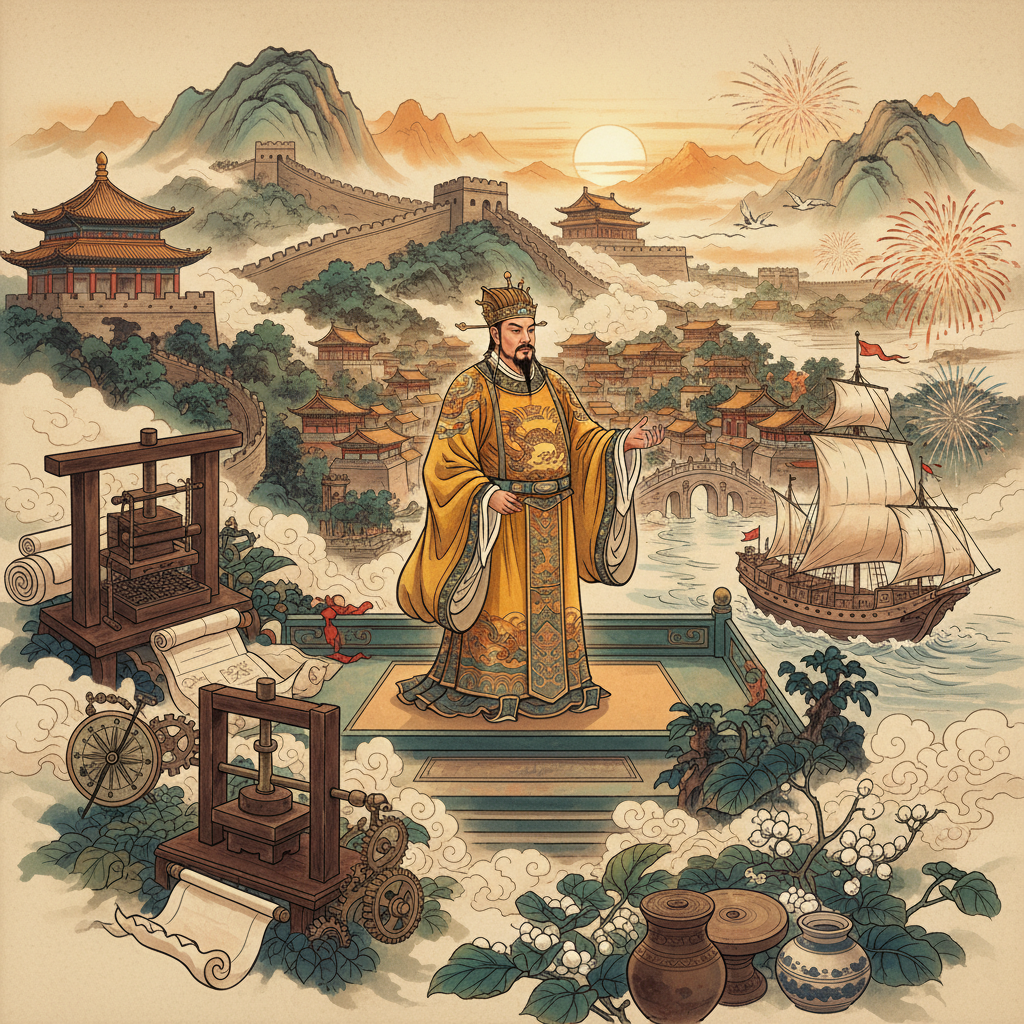
Introduction: The Cradle of Chinese Innovations
Ancient China is renowned as one of the world’s oldest continuous civilizations, with a rich history spanning thousands of years. Beyond its vast dynasties and legendary emperors, China’s greatest legacy lies in its groundbreaking inventions that not only revolutionized Chinese society but also significantly influenced the world. From early innovations in papermaking to advancements in metallurgy, these inventions highlight the ingenuity fostered by various dynastic eras. Understanding the historical context of these creations unveils the cultural values and priorities that shaped ancient Chinese civilization.
The Han Dynasty: Foundations for Scientific Progress
The Han Dynasty (206 BCE – 220 CE) is often regarded as a golden age in Chinese history, not merely for its political stability but also for its remarkable advancements in science and technology. During this era, the invention of paper by Cai Lun marked a pivotal moment. Earlier forms of writing were etched on bamboo or silk, costly and impractical for widespread use. Paper, made from mulberry bark and hemp, democratized access to information and education, fostering the growth of literature, administration, and cultural expression.
Additionally, the Han Dynasty contributed to metallurgy with innovations in casting techniques that produced stronger weapons and tools. The rise of the iron industry during this period drastically improved agricultural productivity and military technology, consolidating the dynasty’s power. These scientific achievements reflect the Han rulers’ encouragement of knowledge and their integration of technological advancements into governance.
Tang and Song Dynasties: Catalysts of Technological Flourishing
The Tang (618–907) and Song (960–1279) dynasties are celebrated for their cultural vibrancy and technological breakthroughs, solidifying China’s reputation as a world leader in innovation. The Song Dynasty, in particular, witnessed the invention of movable type printing by Bi Sheng, transforming the dissemination of knowledge. This innovation simplified printing processes, enabling the mass production of books and classical texts, thus enhancing literacy and education throughout the empire.
Moreover, the Tang and Song periods saw advancements in navigational tools, such as the refinement of the magnetic compass. Initially developed for geomancy and fortune-telling, the compass became a critical maritime instrument that facilitated expansive trade routes and exploration. These technological leaps were intertwined with the flourishing of arts, poetry, and philosophy, illustrating a dynamic era where invention and culture thrived hand in hand.
The Ming Dynasty: Maritime Mastery and Porcelain Perfection
The Ming Dynasty (1368–1644) is famed for its maritime expeditions and exquisite craftsmanship, which included several notable inventions and refinements. Admiral Zheng He’s voyages across the Indian Ocean were made possible by improvements in shipbuilding technology, such as watertight bulkheads that enhanced the seaworthiness of large vessels. These maritime advancements not only demonstrated China’s engineering prowess but also expanded global cultural and economic exchanges during the early 15th century.
In addition, the Ming era perfected porcelain production, turning it into an art form synonymous with Chinese culture. The delicate “blue and white” porcelain became prized worldwide, symbolizing China’s artistic and technical sophistication. This period’s focus on both technical precision and aesthetic innovation indicates how technological inventions were deeply embedded within the cultural identity of the dynasty.
Impact and Cultural Significance of Ancient Chinese Inventions
The inventions across these dynasties reveal how technology was closely linked to governance, economy, and culture. The development of paper and printing facilitated bureaucracy and education; metallurgy supported agriculture and military strength; navigation tools enabled China’s role in global trade networks. Cultural values such as harmony with nature, practical utility, and intellectual curiosity were crucial in motivating these breakthroughs.
Moreover, many ancient Chinese inventions had ripple effects far beyond China’s borders, influencing societies across Asia, the Middle East, and Europe. The Silk Road and maritime routes became conduits for both goods and ideas, allowing Chinese technologies to integrate into global development centuries before the modern age.
Conclusion: Ancient China's Enduring Legacy in Innovation
The legacy of Chinese ancient dynasties lies not just in their majestic palaces or sprawling empires, but significantly in their unparalleled contributions to human civilization through invention. The enduring impact of paper, printing, navigation, and metallurgy underscores how ancient China’s cultural and technological ingenuity continues to inspire the modern world. By reflecting on these innovations within their historical context, we gain deeper appreciation for the complex interplay between culture, governance, and science that defined ancient Chinese society and shaped the course of history worldwide.