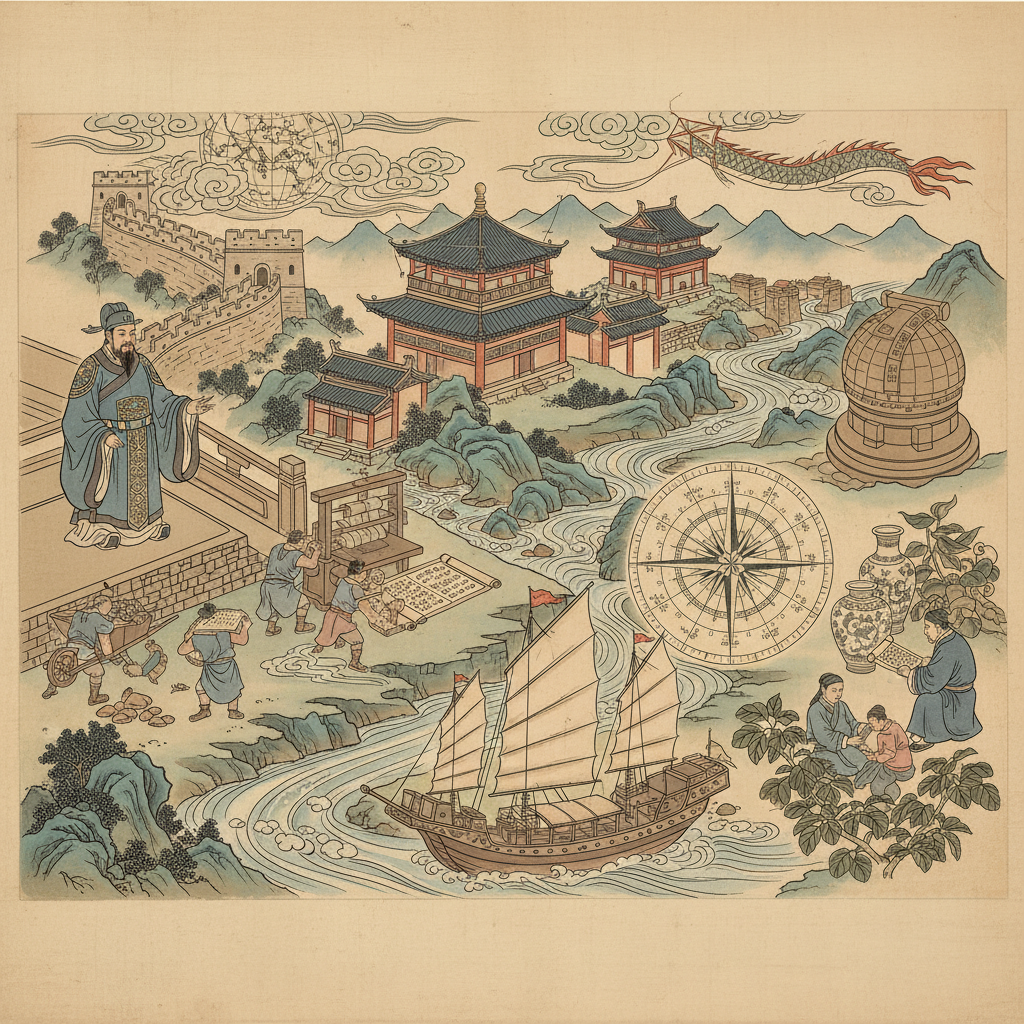
Ancient Innovations: The Bedrock of Chinese Civilization
The history of ancient China spans thousands of years, marked by a series of powerful dynasties and remarkable advancements that have significantly shaped not only Chinese culture but also the world at large. From the Xia Dynasty (c. 2070–1600 BCE) to the Qing Dynasty (1644–1912 CE), each era contributed distinct innovations and cultural practices that still resonate today. Understanding these developments gives us valuable insights into the extraordinary journey of one of the world’s oldest civilizations.
The Four Great Inventions: Pillars of Progress
China is often celebrated for its "Four Great Inventions": paper, gunpowder, the compass, and printing. These inventions fundamentally transformed society, the economy, and warfare, influencing vast regions beyond Chinese borders.
-
Paper: Invented during the Han Dynasty (206 BCE–220 CE) by Cai Lun, paper revolutionized communication and record-keeping. Before its invention, bamboo slips and silk were primarily used, making writing cumbersome and expensive. The accessibility of paper democratized education and literacy among the masses.
-
Gunpowder: Formulated during the Tang Dynasty (618–907 CE), gunpowder changed the landscape of warfare forever. Initially used in fireworks, it found its way into military applications, leading to innovations in weaponry that would spread through trade routes to the Middle East and Europe.
-
The Compass: While navigation techniques existed, the magnetic compass, developed during the Song Dynasty (960–1279 CE), allowed for more precise and reliable travel. This advancement was crucial for maritime exploration, influencing trade and cultural exchanges along the seas.
-
Printing: The invention of block printing during the Tang Dynasty enabled the mass production of texts. It not only preserved literature and classical works but also promoted literacy and learning across social strata.
These inventions exemplify the Chinese spirit of innovation, reflecting their ability to adapt and improve upon technologies that would leave an indelible mark on human history.
The Impact of Dynasties on Technological Advancements
The role of dynasties in fostering innovation can’t be overstated. Each dynasty, through its political stability and cultural ethos, created an environment where creativity thrived.
The Han Dynasty: A Golden Age of Invention
The Han Dynasty laid the groundwork for many technological advancements that followed. The introduction of the waterwheel and improvements in iron casting enabled agriculture to flourish, fostering population growth and the expansion of trade routes.
The Tang Dynasty: A Cultural Renaissance
The Tang Dynasty is often referred to as a golden age for Chinese culture. With its openness to foreign influences, trade along the Silk Road flourished, enabling the exchange of ideas. Innovations in art, music, and literature paralleled technological gains, symbolizing a period of unprecedented progress.
The Song Dynasty: Commercial Revolution
The Song Dynasty witnessed a surge in technological innovation alongside economic transformation. Advances such as the abacus, mechanical clocks, and more efficient agricultural tools underscored a burgeoning market economy that encouraged commerce and trade. An increase in skilled labor also transitioned China into an early form of factory production, setting a precedent for future industrial developments.
The Cultural Significance of Inventions
The inventions of ancient China were not merely practical solutions; they were deeply embedded in the cultural and philosophical psyche of the Chinese people. For instance, the invention of paper contributed to the preservation of Confucian texts, while the compass reflected the Chinese deep connection to navigating moral and spiritual paths alongside physical journeys.
Literature and Education
The availability of printed materials led to a literacy revolution. Educational systems evolved, with classical literature becoming widely accessible, nurturing a society that valued knowledge and moral virtue.
Transformation of Warfare
The introduction of gunpowder transformed not only military strategies but also the social order. Warfare became a key aspect of state-building, leading to shifts in power structures and territorial expansion.
Conclusion: A Legacy of Innovation
The legacy of ancient Chinese innovations continues to influence modern civilization. From the conveniences of paper and the navigational prowess of the compass to the revolutionary implications of gunpowder, these inventions reflect both the ingenuity and the enduring spirit of Chinese culture. As we delve into the history of these advancements, we uncover a narrative of human creativity and resilience that transcends time and geography. Understanding this legacy is not only crucial for appreciating Chinese history but also for recognizing the shared connections that bind us all as a global community.
As we move forward in an age defined by technology and invention, the lessons embedded in ancient Chinese history remind us of the importance of innovation and cultural richness in shaping a better future.