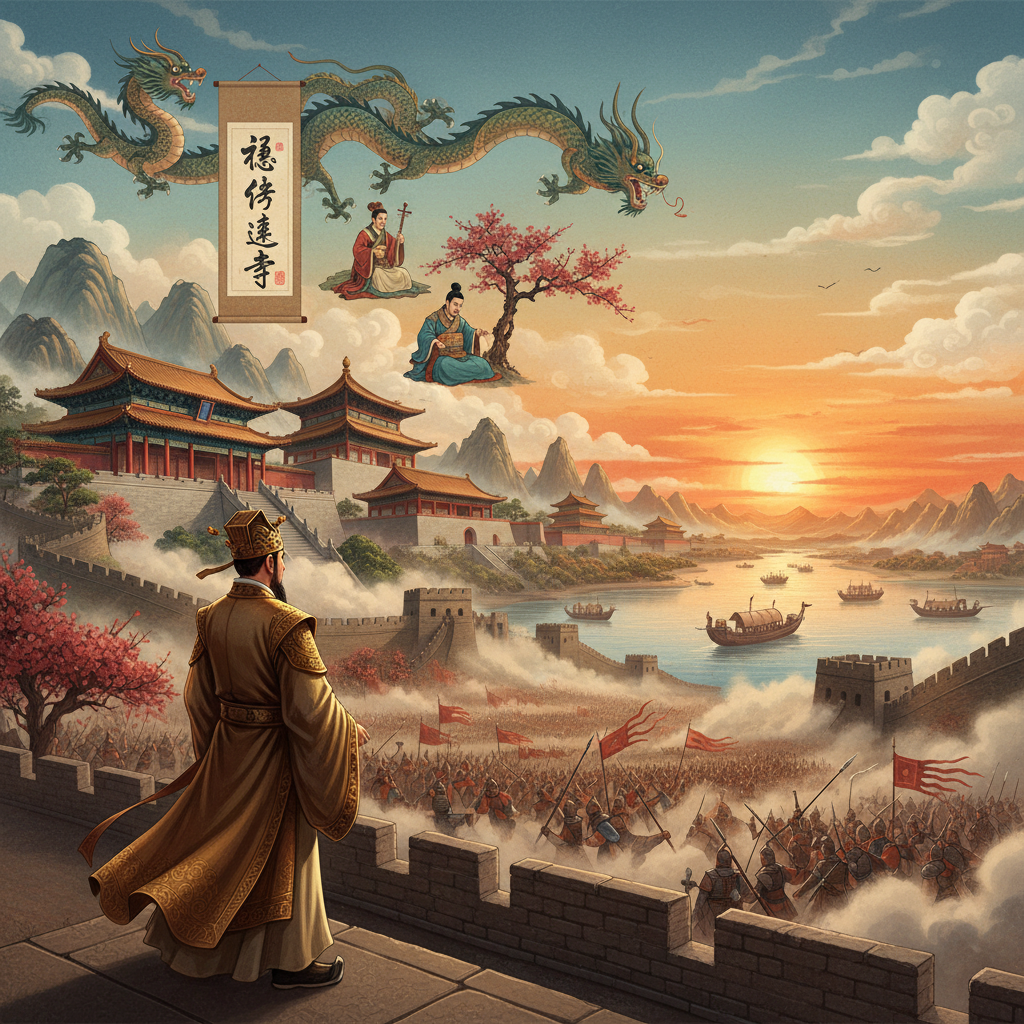
Introduction to Ancient Chinese Emperors
Ancient China boasts a rich tapestry of history, woven together by the lives and legacies of its emperors. Over thousands of years, these powerful figures shaped not only the political landscape but also the cultural identity of a civilization that remains influential today. This article explores the most significant emperors across various dynasties, their contributions, impactful battles, and the lasting cultural significance they embedded in Chinese history.
The Legacy of the Qin Dynasty: Unification Under Qin Shi Huang
The first emperor of China, Qin Shi Huang, ascended to power during the Qin Dynasty (221-206 BC) after unifying the warring states. His legacy is often overshadowed by his authoritarian rule, yet it laid the essential groundwork for a unified Chinese identity. Qin Shi Huang's ambitious projects, such as the initial construction of the Great Wall and the Terracotta Army, symbolize the dynasty's strength and military prowess.
In addition to military unification, he standardized weights, measures, and even script, allowing for improved communication and commerce across regions. The Qin Dynasty, while short-lived, deserves recognition for establishing a centralized state, enabling the flourishing of subsequent dynasties and shaping the framework of governance in China.
The Han Dynasty: Emperors and Cultural Flourishing
The Han Dynasty (206 BC-220 AD), often regarded as a golden age of Chinese civilization, saw emperors like Liu Bang (Emperor Gao) and accomplishments under Emperor Wu. Under their rule, the Han Dynasty expanded China’s territory and influence through strategic military campaigns, including the conquest of the Xiongnu tribes.
Culturally, the Han Dynasty was marked by significant advancements in literature, philosophy, and technology. The adoption of Confucianism as the state ideology elucidated a distinct moral framework, emphasizing virtues such as loyalty and integrity. The invention of paper during this period revolutionized documentation and literature, further anchoring China's cultural legacy.
The Sui and Tang Dynasties: Economic Prosperity and Cultural Exchange
The Sui Dynasty (581-618 AD) served as a crucial transitional period that paved the way for the Tang Dynasty (618-907 AD), regarded as another peak of Chinese civilization. Emperor Yang of Sui initiated the Grand Canal's construction, linking the Yellow River and Yangtze River, which enhanced trade and agricultural output.
The Tang Dynasty heralded an era of cultural cosmopolitanism, thriving on Silk Road trade. Emperors like Taizong promoted the arts, poetry, and Buddhism, creating a cultural synthesis that attracted foreign diplomats and merchants. The era's openness fostered philosophical discourse, artistic expression, and the integration of diverse cultures into the Chinese milieu.
The Ming Dynasty: Navigating Challenges and Achievements
The Ming Dynasty (1368-1644 AD) is heralded for its cultural renaissance and explorative ventures, including the vast maritime expeditions of Admiral Zheng He. Emperor Yongle, one of the most notable Ming emperors, oversaw the construction of the Forbidden City and the compilation of the Yongle Encyclopedia, reflecting the era's intellectual ambition.
Ming emperors adeptly navigated foreign challenges while solidifying national identity through a revival of Confucian values. However, despite their accomplishments, the dynasty faced internal strife and external pressures, ultimately leading to its decline. The Ming narrative serves as a poignant juxtaposition of grandeur and fragility in imperial China’s historical framework.
Cultural Significance of Ancient Chinese Emperors
The emperors of ancient China were not just rulers; they were pivotal in shaping the cultural landscape of one of the world's earliest civilizations. Their patronage of the arts, commitment to establishing educational institutions, and support of philosophical teachings fostered a society that valued knowledge and creativity. The dynastic cycle, characterized by the rise and fall of these emperors, illustrates the ebb and flow of power and cultural significance throughout Chinese history.
Today, the impact of these rulers is still palpable. The philosophies, artistic expressions, and social structures they endorsed have permeated modern Chinese culture, influencing everything from governance to social interactions. The legacy of ancient emperors continues to inspire national pride and cultural continuity, making them timeless figures in the annals of world history.
Conclusion: Emperors as Cultural Icons
In conclusion, the emperors of ancient China played an essential role in forging a cohesive identity that transcended their reigns. Their stories intertwine with the triumphs and challenges of multiple dynasties, each leaving a lasting legacy that continues to resonate within modern Chinese society. By examining the lives of these influential leaders, we gain insight into the cultural evolution of China—making their stories vital to understanding the nation's past and its enduring influence on the world stage.