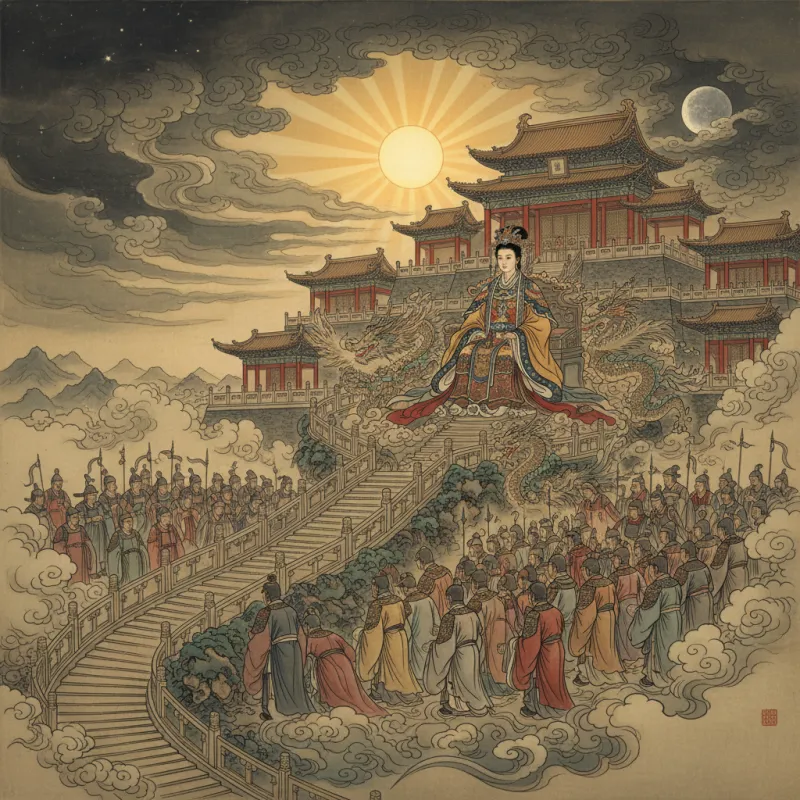
Wu Zetian: China Only Female Emperor
⏱️ 21 min read📅 Updated April 10, 2026⏱️ 21 min read📅 Updated April 10, 2026⏱️ 20 min read📅 Updated April 09, 2026Wu Zetian: China's Only Female Emperor
The Woman Who Shattered the Celestial Ceiling
In the male-dominated world of imperial China, where the concept of tianming (天命, Mandate of Heaven) was believed to pass exclusively through patrilineal succession, one woman achieved the impossible. Wu Zetian (武則天, 624-705 CE) didn't merely influence power from behind a screen—she seized the dragon throne itself, proclaimed her own dynasty, and ruled as huangdi (皇帝, emperor) in her own right. Her story is one of ruthless ambition, political genius, and a reign that, despite centuries of historical condemnation, brought prosperity and reform to Tang China.
From Concubine to Empress: The Early Ascent
Born Wu Zhao (武曌) into a wealthy merchant family in Wenshui, Shanxi province, Wu Zetian entered the imperial palace at age fourteen as a cairen (才人, fifth-rank concubine) to Emperor Taizong. Her beauty was noted, but more significantly, she possessed exceptional intelligence and literacy—rare qualities that would prove far more valuable than physical charms alone.
When Emperor Taizong died in 649 CE, Wu faced the fate of all imperial concubines: retirement to a Buddhist convent, her head shaved, her political life seemingly over. According to tradition, she should have spent her remaining years in religious contemplation. But Wu had already caught the eye of Taizong's son, the crown prince Li Zhi, who would become Emperor Gaozong. In a scandalous breach of Confucian propriety—which considered such a relationship tantamount to incest—Gaozong recalled Wu from the convent in 651 CE.
This was Wu's first demonstration of her ability to transcend social boundaries. Within four years, she had eliminated her rivals through a combination of political maneuvering and, according to historical accounts, ruthless violence. The most infamous incident involved the death of her own infant daughter, whose murder she allegedly blamed on Empress Wang, leading to Wang's deposition and gruesome execution. By 655 CE, Wu Zhao had become Empress Wu, the huanghou (皇后).
The Power Behind the Throne
Emperor Gaozong suffered from chronic illness, including debilitating headaches and vision problems that modern historians speculate may have been caused by hypertension or stroke. As his health declined, Empress Wu increasingly handled state affairs, sitting behind a screen during imperial audiences—a practice known as chuilian tingzheng (垂簾聽政, "listening to politics from behind a curtain"). This arrangement, while not unprecedented for empress dowagers, was extraordinary for a reigning emperor's consort.
Wu demonstrated remarkable administrative capability. She was well-versed in Confucian classics, Buddhist scriptures, and historical precedents. She expanded the keju (科舉, civil service examination system), creating new categories that tested candidates on practical governance rather than merely classical knowledge. This reform opened bureaucratic positions to a broader range of talented individuals, many of whom owed their careers—and loyalty—directly to her.
Her intelligence network was legendary. Wu established the tongzheng (銅匭, bronze boxes) system, where citizens could submit sealed accusations or suggestions directly to the throne, bypassing traditional bureaucratic channels. This created an atmosphere of surveillance that kept potential opponents fearful, but also provided valuable information about corruption and maladministration throughout the empire.
The Zhou Dynasty: A Woman's Reign
When Emperor Gaozong died in 683 CE, Wu initially ruled as empress dowager through her sons, first Emperor Zhongzong and then Emperor Ruizong. But in 690 CE, at the age of 66, she took the unprecedented step of declaring herself emperor—not empress regnant, but huangdi, a title that had been exclusively masculine for over two millennia.
She proclaimed a new dynasty, the Zhou (周), interrupting the Tang dynasty that had ruled since 618 CE. She took the regal name Shengshen Huangdi (聖神皇帝, "Holy and Divine Emperor") and later Zetian Dasheng Huangdi (則天大聖皇帝, "Emperor Who Accords with Heaven and Manifests Great Sagacity"). The name "Wu Zetian" by which she is commonly known today means "Wu who accords with Heaven."
This was not merely symbolic. Wu commissioned scholars to create new Chinese characters, including a new character for her personal name, zhao (曌), combining the characters for sun (日) and moon (月) above the character for sky (空), symbolizing her illumination of the heavens. She ordered the compilation of the Dayun jing (大雲經, Great Cloud Sutra), a Buddhist text that prophesied the reincarnation of the Bodhisattva Maitreya as a female monarch who would rule over a universal kingdom—conveniently legitimizing her rule through religious authority.
Governance and Reform
Despite the scandalous nature of her rise to power, Wu Zetian's reign was marked by effective governance and significant reforms. The empire remained stable, prosperous, and secure—no small achievement for a ruler facing constant legitimacy challenges.
Administrative Innovation
Wu continued expanding the examination system, personally presiding over the dianshi (殿試, palace examinations) where she could directly select officials. She created the celiang (策量, policy essay) examination, which tested candidates' ability to propose practical solutions to contemporary problems. This meritocratic approach brought fresh talent into government and reduced the power of aristocratic families who had traditionally dominated high offices.
She was also known for promoting capable officials regardless of their social background. Notable appointments included the brilliant administrator Di Renjie (狄仁傑), who served as her chancellor and became one of her most trusted advisors despite initially opposing her usurpation of the throne.
Military Success
Under Wu's rule, the Tang military maintained its dominance over the Silk Road trade routes and expanded Chinese influence into Central Asia. She appointed capable generals like Wang Xiaojie, who successfully campaigned against the Tibetan Empire and the Turkic Khaganates. The empire's borders remained secure, and trade flourished along the Sichou zhi Lu (絲綢之路, Silk Road).
Cultural Patronage
Wu was a significant patron of Buddhism, which she favored over Confucianism—partly because Buddhist doctrine was more accommodating to female authority than Confucian patriarchy. She sponsored the construction of magnificent Buddhist temples, including additions to the Longmen Grottoes near Luoyang, where a massive statue of Vairocana Buddha was carved, reportedly modeled on Wu's own features.
She moved the capital from Chang'an to Luoyang, her power base, and transformed it into a magnificent city that rivaled Constantinople and Baghdad as one of the world's great metropolises.
The Reign of Terror
Wu Zetian's achievements cannot be separated from the brutal methods she employed to maintain power. She relied heavily on a network of secret police and informers, most notoriously the officials Suo Yuanli and Zhou Xing, who developed elaborate torture devices and extracted confessions from suspected conspirators.
The luo zhi yu (羅織獄, "weaving nets prison") system encouraged denunciations, and thousands of officials, aristocrats, and members of the Li imperial family were executed, exiled, or forced to commit suicide. Entire families were exterminated on suspicion of disloyalty. The atmosphere of terror was so pervasive that officials reportedly lived in constant fear.
Historical sources—written by Confucian scholars hostile to her rule—may have exaggerated these atrocities, but there is no doubt that Wu maintained power through intimidation and violence. The question remains whether her methods were substantially different from those employed by male emperors, or whether her gender made her actions seem more transgressive to traditional historians.
The Fall and Legacy
By 705 CE, Wu Zetian was 80 years old and in declining health. A palace coup led by officials including her former chancellor Zhang Jianzhi forced her to abdicate in favor of her son, who was restored as Emperor Zhongzong, reviving the Tang dynasty. Wu died later that year, and significantly, her final testament requested that she be buried as huanghou (empress) rather than huangdi (emperor), and that her tombstone bear no inscription—perhaps recognizing that history would judge her harshly.
Indeed, traditional Confucian historians condemned Wu Zetian as a usurper who violated the natural order. The Zizhi Tongjian (資治通鑒, Comprehensive Mirror in Aid of Governance), compiled in the 11th century, portrayed her as a scheming, murderous figure whose reign represented a dangerous aberration. For centuries, she served as a cautionary tale about the dangers of female political power.
Modern Reassessment
Contemporary historians have begun to reassess Wu Zetian's legacy with more nuance. While not excusing her brutality, scholars recognize several important points:
Political Competence: The empire remained stable, prosperous, and powerful throughout her reign. Economic policies were sound, the bureaucracy functioned effectively, and military campaigns were generally successful.
Institutional Innovation: Her expansion of the examination system and promotion of merit over birth had lasting positive effects on Chinese governance.
Gender Bias in Sources: Most historical accounts were written by Confucian scholars with strong ideological opposition to female rule. Stories of her sexual impropriety and excessive cruelty may have been exaggerated to delegitimize her reign.
Comparative Context: Male emperors who employed similar methods of terror and violence—including Tang Taizong, widely celebrated as one of China's greatest rulers—are judged by different standards.
Conclusion: The Impossible Achievement
Wu Zetian remains a profoundly controversial figure. She was undoubtedly ruthless, manipulative, and willing to eliminate anyone who threatened her power—including family members. Yet she was also intelligent, capable, and effective as a ruler. She governed a vast empire successfully for over four decades, whether as empress, empress dowager, or emperor.
Her greatest achievement was not merely reaching the throne, but maintaining power in a system designed to exclude women from political authority. She had to be more ruthless, more clever, and more capable than any male rival because she lacked the automatic legitimacy that gender provided in imperial China.
That no other woman ever replicated her achievement in over a thousand years of subsequent Chinese imperial history testifies both to her extraordinary abilities and to the formidable barriers she overcame. Wu Zetian proved that a woman could wield supreme power as effectively as any man—a demonstration so threatening to patriarchal order that Chinese civilization ensured it would never happen again.
Her blank tombstone at the Qianling Mausoleum, standing alongside that of Emperor Gaozong, remains one of China's most enigmatic monuments. Whether it represents humility, defiance, or an acknowledgment that her story was too complex for any inscription, it stands as a fitting symbol for a woman who defied every convention of her age and whose legacy continues to provoke debate thirteen centuries after her death.
About the Author
Dynasty Scholar — A specialist in women history and Chinese cultural studies.