Traditional Chinese Medicine: A Historical Overview
⏱️ 21 min read📅 Updated April 10, 2026⏱️ 21 min read📅 Updated April 10, 2026⏱️ 20 min read📅 Updated April 09, 2026Traditional Chinese Medicine: A Historical Overview
The Foundations of an Ancient Healing System
Traditional Chinese Medicine (TCM), known as 中医 (zhōngyī) or "Chinese medicine," represents one of humanity's oldest continuous medical traditions, with documented practices stretching back over 2,500 years. Unlike Western biomedicine's focus on isolating pathogens and treating specific symptoms, TCM developed as a holistic system that views the human body as an integrated whole, inseparable from the natural world and governed by the same fundamental principles that regulate the cosmos.
The philosophical underpinnings of TCM emerged during China's formative intellectual period, drawing heavily from Daoist and Confucian thought. The concept of 气 (qì), often translated as "vital energy" or "life force," became central to understanding health and disease. Practitioners believed that qì flows through the body along specific pathways called 经络 (jīngluò) or meridians, and that illness results when this flow becomes blocked, deficient, or excessive.
The Classical Texts: Codifying Medical Knowledge
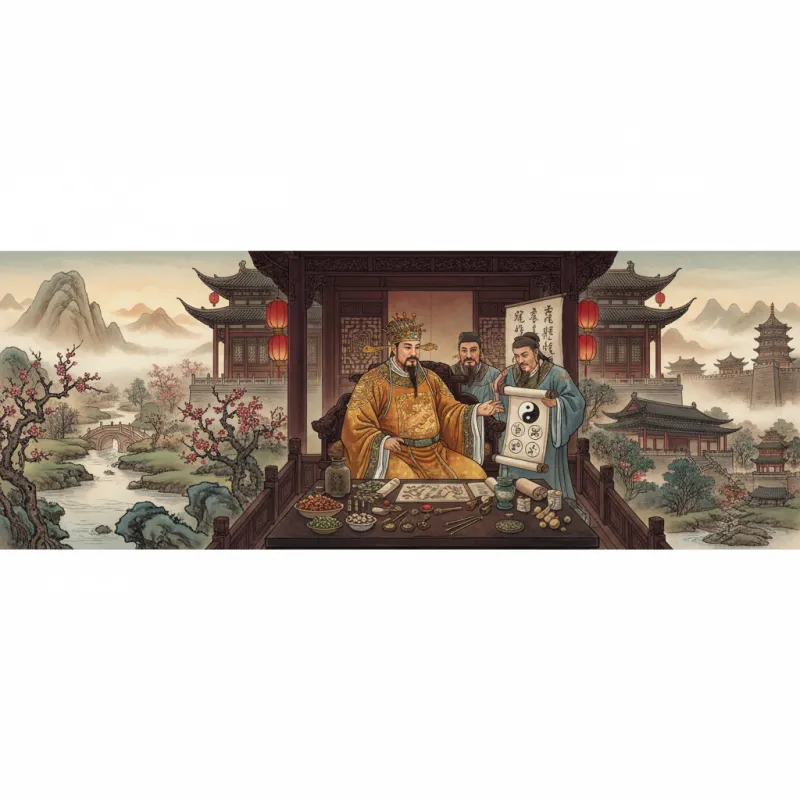
The foundation of TCM theory was established in several seminal texts that continue to influence practice today. The most important is the 黄帝内经 (Huángdì Nèijīng), or "Yellow Emperor's Inner Canon," traditionally dated to around 300-100 BCE during the Warring States period, though likely compiled over several centuries. This text, structured as a dialogue between the legendary Yellow Emperor and his physician Qi Bo, systematically presents theories of anatomy, physiology, pathology, diagnosis, and treatment.
The Huángdì Nèijīng introduced the concept of 阴阳 (yīnyáng), the complementary forces whose dynamic balance maintains health. Yang represents qualities like heat, activity, and brightness, while yin embodies cold, rest, and darkness. The text also elaborated the theory of 五行 (wǔxíng), the Five Phases—wood, fire, earth, metal, and water—which correspond to organs, seasons, emotions, and countless other phenomena in an intricate web of correspondences.
Another crucial classical work is the 伤寒杂病论 (Shānghán Zábìng Lùn), "Treatise on Cold Damage and Miscellaneous Diseases," compiled by Zhang Zhongjing around 200 CE during the late Han Dynasty. This practical clinical manual provided specific herbal formulas for treating various disease patterns, establishing a methodology that physicians would follow for centuries. Zhang's work emerged from personal tragedy—he lost many family members to epidemic disease—and his systematic approach to diagnosis and treatment represented a major advancement in clinical medicine.
The 神农本草经 (Shénnóng Běncǎo Jīng), "Divine Farmer's Materia Medica," compiled during the Han Dynasty, catalogued 365 medicinal substances, classifying them according to their properties and therapeutic effects. This pharmacological foundation would expand dramatically over subsequent centuries, with the 本草纲目 (Běncǎo Gāngmù), "Compendium of Materia Medica," compiled by Li Shizhen in 1578 during the Ming Dynasty, eventually documenting 1,892 substances and 11,096 prescriptions.
Diagnostic Methods: Reading the Body's Signs
TCM developed sophisticated diagnostic techniques that remain distinctive today. The practice of 望闻问切 (wàng wén wèn qiè)—looking, listening/smelling, asking, and palpating—constitutes the four pillars of diagnosis.
望诊 (wàngzhěn), or inspection, involves carefully observing the patient's spirit, complexion, body shape, and particularly the tongue. Tongue diagnosis became remarkably refined, with practitioners analyzing the tongue's color, coating, shape, and moisture to determine the nature and location of imbalances. A pale tongue might indicate blood deficiency, while a red tongue with yellow coating could suggest heat patterns.
闻诊 (wénzhěn) encompasses listening to the patient's voice, breathing, and cough, as well as detecting body odors. Different sounds and smells correspond to specific organ systems and pathological conditions.
问诊 (wènzhěn), the inquiry process, involves detailed questioning about symptoms, medical history, lifestyle, diet, emotions, and sleep patterns. TCM physicians recognized that emotional states profoundly affect physical health, with the 七情 (qīqíng), or seven emotions—joy, anger, worry, pensiveness, sadness, fear, and fright—each associated with specific organs.
切诊 (qièzhěn), or palpation, most famously includes pulse diagnosis. TCM pulse-taking is extraordinarily nuanced, with practitioners distinguishing up to 28 different pulse qualities at three positions on each wrist, each position corresponding to different organs. A "wiry" pulse might indicate liver problems, while a "slippery" pulse could suggest phlegm accumulation or pregnancy. Master physicians claimed they could diagnose conditions solely through pulse examination, though this skill required years of training.
Therapeutic Modalities: The Tools of Healing
Herbal Medicine
中药 (zhōngyào), or Chinese herbal medicine, forms the backbone of TCM treatment. Unlike Western pharmaceuticals that typically use single active compounds, Chinese herbal formulas combine multiple ingredients in carefully balanced prescriptions. This approach, called 君臣佐使 (jūn chén zuǒ shǐ)—emperor, minister, assistant, and envoy—assigns different roles to herbs within a formula. The "emperor" herb addresses the primary condition, "ministers" support the main therapeutic action, "assistants" treat secondary symptoms or moderate harsh effects, and "envoys" guide the formula to specific body areas.
Classic formulas like 四物汤 (Sìwù Tāng), "Four Substance Decoction," used for blood deficiency, or 六味地黄丸 (Liùwèi Dìhuáng Wán), "Six Ingredient Pill with Rehmannia," for kidney yin deficiency, have been prescribed for centuries with modifications tailored to individual patients. This principle of 辨证论治 (biànzhèng lùnzhì), "pattern differentiation and treatment determination," emphasizes that two patients with the same Western diagnosis might receive entirely different TCM treatments based on their unique constitutional patterns.
Acupuncture and Moxibustion
针灸 (zhēnjiǔ), combining acupuncture (针, zhēn) and moxibustion (灸, jiǔ), represents TCM's most internationally recognized therapy. Acupuncture involves inserting fine needles at specific points along the meridians to regulate qì flow. Archaeological evidence suggests acupuncture's origins date to the Neolithic period, with stone needles (砭石, biānshí) found at sites over 4,000 years old.
The systematization of acupuncture points occurred gradually, with the 针灸甲乙经 (Zhēnjiǔ Jiǎyǐ Jīng), "Systematic Classic of Acupuncture and Moxibustion," compiled by Huangfu Mi in 282 CE, documenting 349 points. By the Ming Dynasty, the standard system of 365 points along 14 major meridians had been established, corresponding symbolically to the days of the year.
Moxibustion involves burning dried mugwort (艾, ài) near or on acupuncture points to warm the meridians and expel cold. This technique proved particularly valuable for chronic conditions and pain disorders. The practice became so integral that the Chinese character for acupuncture (灸) literally depicts a hand holding burning moxa over a person.
Other Therapeutic Techniques
推拿 (tuīná), Chinese therapeutic massage, uses specific hand techniques to manipulate soft tissues, joints, and acupuncture points. Unlike relaxation massage, tuīná serves as a formal medical treatment, particularly effective for musculoskeletal conditions and pediatric disorders.
拔罐 (báguàn), or cupping therapy, creates suction on the skin using heated glass or bamboo cups, promoting blood circulation and releasing muscle tension. This ancient technique gained modern visibility when Olympic athletes appeared with characteristic circular marks.
气功 (qìgōng), combining movement, breathing, and meditation, serves both therapeutic and preventive functions. Practices like 太极拳 (tàijíquán), Tai Chi, emerged from martial arts traditions but became recognized for health benefits, particularly for elderly practitioners seeking to maintain balance, flexibility, and mental clarity.
Imperial Patronage and Institutional Development
Chinese emperors played crucial roles in advancing medical knowledge. The Tang Dynasty (618-907 CE) established the 太医署 (Tàiyī Shǔ), Imperial Medical Bureau, which included specialized departments, formal medical education, and standardized examinations. This represented one of the world's first government-sponsored medical education systems.
The Song Dynasty (960-1279 CE) saw remarkable developments, including the publication of illustrated anatomical texts and the establishment of pharmacies that dispensed standardized herbal formulas. The government commissioned the 太平圣惠方 (Tàipíng Shènghùi Fāng), a massive compilation of 16,834 prescriptions, demonstrating state commitment to preserving and disseminating medical knowledge.
The Ming Dynasty (1368-1644 CE) produced Li Shizhen's monumental Běncǎo Gāngmù, which took 27 years to complete and represented the culmination of centuries of pharmacological knowledge. This work influenced not only Chinese medicine but also early European understanding of Asian natural history.
Regional Variations and Schools of Thought
TCM was never monolithic. Different regions and historical periods produced distinct schools of thought. The 伤寒学派 (Shānghán Xuépài), Cold Damage School, emphasized Zhang Zhongjing's systematic approach to epidemic diseases. The 温病学派 (Wēnbìng Xuépài), Warm Disease School, emerged during the Qing Dynasty to address febrile diseases that didn't fit Cold Damage patterns, developing new diagnostic and treatment methods.
The 金元四大家 (Jīn Yuán Sì Dàjiā), Four Great Masters of the Jin-Yuan period (1115-1368 CE), each emphasized different aspects of pathology and treatment. Liu Wansu focused on fire and heat, Zhang Congzheng on purging methods, Li Gao on strengthening the spleen and stomach, and Zhu Danxi on nourishing yin. These diverse perspectives enriched TCM theory and expanded therapeutic options.
Modern Challenges and Global Spread
The 20th century brought existential challenges to TCM. During the Republican period (1912-1949), Western-trained physicians and modernizers argued for abolishing traditional medicine as unscientific. The proposal sparked fierce debate, with TCM defenders arguing that China's medical heritage deserved preservation and scientific investigation rather than wholesale rejection.
After 1949, the People's Republic of China adopted a policy of integrating Chinese and Western medicine, establishing research institutes and standardizing TCM education. This political support ensured survival but also transformed practice, as TCM adapted to modern clinical settings and research methodologies.
Today, TCM has spread globally, with acupuncture particularly gaining acceptance. The World Health Organization included some TCM practices in its International Classification of Diseases in 2019, though this decision remained controversial. Modern research investigates TCM through pharmacological studies, clinical trials, and neuroimaging, seeking to understand mechanisms behind traditional practices.
Conclusion: A Living Tradition
Traditional Chinese Medicine represents more than a collection of therapeutic techniques—it embodies a comprehensive worldview that sees humans as integral parts of nature, subject to the same patterns and principles governing the cosmos. While modern biomedicine excels at acute interventions and technological solutions, TCM offers approaches to chronic conditions, preventive care, and holistic wellness that continue attracting patients worldwide.
The tradition faces ongoing questions about standardization, evidence standards, and integration with modern medicine. Yet its persistence across millennia, its sophisticated theoretical framework, and its practical therapeutic results suggest that TCM contains valuable knowledge that transcends cultural boundaries. As healthcare systems worldwide grapple with chronic disease, aging populations, and the limitations of purely technological approaches, the holistic principles of Traditional Chinese Medicine may offer insights increasingly relevant to contemporary medical challenges.
About the Author
Dynasty Scholar — A specialist in medicine and Chinese cultural studies.
Related Articles
The History of Acupuncture: From Ancient Practice to Modern Science
From Ancient Practice to Modern Science...
Chinese Herbal Medicine: 2000 Years of Plant-Based Healing
2000 Years of Plant-Based Healing...
Plagues and Epidemics in Chinese History
Plagues and Epidemics in Chinese History...
Ancient Chinese Medicine: A Look into Dynasties and Healing Practices
Explore the rich history of ancient Chinese medicine and its evolution through the dynasties....