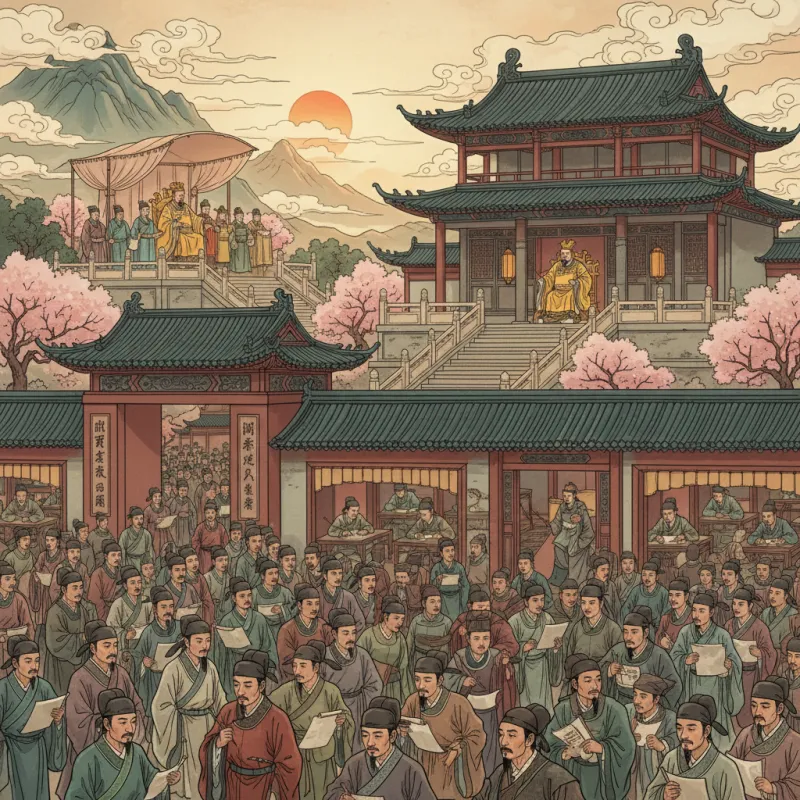
The Imperial Examination System: Meritocracy in Ancient China
⏱️ 26 min read📅 Updated April 10, 2026⏱️ 26 min read📅 Updated April 10, 2026⏱️ 25 min read📅 Updated April 09, 2026The Imperial Examination System: Meritocracy in Ancient China
Introduction: A Revolutionary Path to Power
For over thirteen centuries, the Imperial Examination System (科举制度, kējǔ zhìdù) stood as one of the most remarkable innovations in human governance. This sophisticated system of civil service recruitment transformed Chinese society by establishing merit, rather than birth, as the primary criterion for government service. Beginning in the Sui Dynasty (581-618 CE) and reaching its zenith during the Tang and Song dynasties, the examination system created a unique pathway for talented individuals from humble backgrounds to ascend to the highest echelons of imperial administration.
The system's influence extended far beyond China's borders. European Enlightenment thinkers, including Voltaire, admired it as a rational alternative to hereditary privilege. The British civil service examinations, established in the 19th century, drew direct inspiration from the Chinese model. Understanding the kējǔ system reveals not only the mechanics of imperial governance but also the values, aspirations, and social dynamics that shaped Chinese civilization for over a millennium.
Origins and Early Development
The Pre-Examination Era
Before the formal establishment of the examination system, Chinese rulers employed various methods to select officials. During the Han Dynasty (206 BCE - 220 CE), the chájǔ (察举) system recommended candidates based on reputation and moral character. Local officials would nominate individuals deemed virtuous and talented, but this system inevitably favored the well-connected and wealthy families who could afford classical education.
The Nine Ranks System (jiǔpǐn zhōngzhèng zhì, 九品中正制) of the Wei and Jin dynasties (220-420 CE) further entrenched aristocratic privilege. Officials were classified into nine ranks, and positions were largely monopolized by powerful clans. This created a hereditary elite that threatened to undermine imperial authority itself.
The Sui Dynasty Innovation
Emperor Yang of Sui (隋炀帝, Suí Yángdì) formally established the examination system in 605 CE, though his father, Emperor Wen, had laid the groundwork. This revolutionary reform aimed to break the stranglehold of aristocratic families on government positions and create a bureaucracy loyal to the emperor rather than to regional power brokers.
The early examinations tested candidates on Confucian classics, literary composition, and administrative knowledge. The jìnshì (进士, "presented scholar") degree, which would become the most prestigious qualification, was established during this period. Though the Sui Dynasty was short-lived, its examination system survived and flourished under subsequent dynasties.
The Golden Age: Tang and Song Dynasties
Tang Dynasty Refinements
The Tang Dynasty (618-907 CE) expanded and systematized the examination structure. Multiple examination levels emerged, creating a hierarchical ladder of achievement. The xiùcái (秀才, "cultivated talent"), jǔrén (举人, "recommended man"), and jìnshì degrees formed the core progression, though the terminology and requirements evolved over time.
During the Tang, the examination system coexisted with other recruitment methods, including recommendation and hereditary privilege through the yīnyì (荫袭) system, which allowed sons of high officials to enter government service. Nevertheless, examination graduates increasingly dominated the upper ranks of the bureaucracy. Famous Tang poets like Bai Juyi (白居易, Bái Jūyì) and Wang Wei (王维, Wáng Wéi) were both successful examination candidates, illustrating how literary excellence and bureaucratic achievement intertwined.
Song Dynasty Expansion
The Song Dynasty (960-1279 CE) represents the examination system's golden age. Emperor Taizu (宋太祖, Sòng Tàizǔ) and his successors dramatically expanded the system's scope and importance. The number of examination candidates increased exponentially, with tens of thousands competing in provincial examinations.
The Song emperors introduced crucial reforms to ensure fairness. The mìfēng (弥封) system sealed candidates' names on examination papers to prevent favoritism. The ténglù (誊录) system required clerks to recopy all papers in identical handwriting, eliminating the possibility of recognizing candidates by their calligraphy. These innovations demonstrated a sophisticated understanding of how to minimize corruption and bias.
During the Song, the examination curriculum emphasized the Confucian classics, particularly the Four Books (Sìshū, 四书): the Analects (Lúnyǔ, 论语), Mencius (Mèngzǐ, 孟子), Great Learning (Dàxué, 大学), and Doctrine of the Mean (Zhōngyōng, 中庸). The philosopher Zhu Xi (朱熹, Zhū Xī) compiled authoritative commentaries on these texts that became required reading for all candidates.
The Examination Structure and Process
The Three-Tiered System
By the Ming (1368-1644) and Qing (1644-1912) dynasties, the examination system had evolved into a rigorous three-tiered structure that tested candidates multiple times over many years.
The county and prefectural examinations (tóngyì and fǔyì, 童试 and 府试) represented the first hurdle. Success here earned the shēngyuán (生员, "government student") degree, commonly called xiùcái. These degree-holders gained social prestige and tax exemptions but held no official position. The pass rate was typically around 1-2%, and candidates might attempt these examinations dozens of times over their lifetimes.
The provincial examinations (xiāngshì, 乡试) occurred every three years in provincial capitals. Candidates spent three days and nights locked in tiny examination cells (hàofáng, 号房), each approximately three feet wide and four feet deep. They composed essays on assigned topics from the Confucian classics, demonstrating not only knowledge but also literary skill in the highly formalized bāgǔwén (八股文, "eight-legged essay") style. Success brought the jǔrén degree and eligibility for official appointment.
The metropolitan examinations (huìshì, 会试) took place in Beijing, also triennially. Those who passed became gòngshì (贡士, "tribute scholars") and were eligible for the final test.
The palace examination (diànshì, 殿试), held in the Forbidden City's Hall of Supreme Harmony, was presided over by the emperor himself. This examination ranked the gòngshì candidates, with the top three receiving special honors: zhuàngyuán (状元, first place), bǎngyǎn (榜眼, second place), and tànhuā (探花, third place). All palace examination participants received the jìnshì degree, the pinnacle of scholarly achievement.
The Examination Experience
The examination experience was grueling. Candidates brought their own food, water, bedding, and writing materials into the examination cells. They wrote by candlelight, slept on wooden boards, and endured extreme weather conditions. Deaths from illness, exhaustion, or even suicide were not uncommon during the three-day ordeal.
The bāgǔwén essay format, standardized during the Ming Dynasty, required rigid adherence to structural rules. Essays consisted of eight sections with prescribed rhetorical patterns, demonstrating the candidate's mastery of classical Chinese prose and Confucian orthodoxy. While critics later condemned this format as stifling creativity, it provided an objective standard for evaluating thousands of candidates.
Social Impact and Mobility
Creating a Scholar-Gentry Class
The examination system created the shìdàfū (士大夫, scholar-official) class, which dominated Chinese society for centuries. This class combined Confucian learning with bureaucratic power, creating a unique social stratum that was neither purely hereditary aristocracy nor common peasantry.
Examination success brought immense prestige. Families celebrated a jìnshì graduate with elaborate ceremonies, and communities erected memorial arches (páifāng, 牌坊) to honor local scholars who achieved high degrees. The zhuàngyuán, in particular, became legendary figures, their names recorded in history and their achievements celebrated in popular culture.
Genuine Social Mobility
Despite significant barriers, the examination system did enable genuine social mobility. Studies of Ming and Qing examination records reveal that approximately 30-40% of jìnshì graduates came from families with no history of degree-holding for three generations. This represents remarkable upward mobility for a pre-modern society.
The story of Fan Zhongyan (范仲淹, Fàn Zhòngyan, 989-1052), a Song Dynasty statesman, exemplifies this possibility. Born into poverty after his father's death, Fan studied by candlelight, sometimes eating only porridge. He passed the jìnshì examination and rose to become one of the most influential officials and reformers of his era, famous for his declaration: "Be the first to worry about the world's troubles, and the last to enjoy its pleasures" (先天下之忧而忧,后天下之乐而乐, xiān tiānxià zhī yōu ér yōu, hòu tiānxià zhī lè ér lè).
Limitations and Inequalities
However, the system's meritocratic ideals faced practical limitations. Preparing for the examinations required years of intensive study, which only families with sufficient wealth could afford. Poor families needed their sons' labor for survival, making prolonged education impossible. Additionally, women were entirely excluded from the examination system, though some educated women achieved literary fame through other channels.
Regional quotas, implemented to ensure geographic diversity in the bureaucracy, created disparities. Candidates from culturally advanced regions like Jiangnan faced stiffer competition than those from frontier areas. The Qing Dynasty, ruled by Manchus, also maintained separate quotas for Manchu and Han Chinese candidates, reflecting ethnic considerations in governance.
Criticisms and Decline
Contemporary Critiques
Even during its height, the examination system faced criticism. Some argued that the bāgǔwén format emphasized memorization and formulaic writing over genuine understanding or practical skills. The curriculum's exclusive focus on Confucian classics meant that officials often lacked technical knowledge in areas like mathematics, engineering, or military strategy.
The Qing scholar Gu Yanwu (顾炎武, Gù Yánwǔ, 1613-1682) criticized the system for producing scholars who could write elegant essays but knew nothing of practical governance or the real conditions of the people. He advocated for jīngshì zhìyòng (经世致用, "statecraft and practical learning"), emphasizing applicable knowledge over abstract classical learning.
The 19th Century Crisis
The 19th century brought unprecedented challenges. Western military technology and scientific knowledge exposed the limitations of traditional Confucian education. China's defeats in the Opium Wars (1839-1842, 1856-1860) and the Sino-Japanese War (1894-1895) demonstrated that classical learning alone could not defend the nation against modern powers.
Reformers like Kang Youwei (康有为, Kāng Yǒuwéi) and Liang Qichao (梁启超, Liáng Qǐchāo) argued for modernizing the examination curriculum to include Western science, mathematics, and political theory. The Hundred Days' Reform of 1898 attempted such changes, but conservative opposition led to its failure.
Abolition and Legacy
In 1905, the Qing government finally abolished the examination system, ending over 1,300 years of tradition. This decision reflected recognition that China needed a modern education system to survive in the 20th century. The last zhuàngyuán, Liu Chunlin (刘春霖, Liú Chūnlín), was selected in 1904.
The abolition created a cultural crisis. The examination system had provided clear standards for success, social mobility pathways, and ideological unity. Its disappearance left a vacuum that contributed to the intellectual and political turmoil of early 20th-century China.
Enduring Influence
Modern Echoes
The examination system's legacy persists in contemporary China and East Asia. The gāokǎo (高考, national college entrance examination) in China, while testing modern subjects, mirrors the old system's emphasis on rigorous, standardized testing as a gateway to social advancement. The intense pressure, family investment, and social significance surrounding the gāokǎo echo the examination culture of imperial times.
South Korea's suneung and Japan's university entrance examinations similarly reflect Confucian values of educational achievement and meritocratic advancement. The "examination hell" (shìyàn dìyù, 试验地狱) that students endure represents a modern manifestation of ancient traditions.
Global Impact
The examination system's influence extended globally. When British colonial administrators sought to reform their civil service in the 1850s, they explicitly modeled their competitive examinations on the Chinese system. The Northcote-Trevelyan Report of 1854 recommended merit-based recruitment through examinations, transforming British governance.
Today, standardized testing for civil service, professional licensing, and educational advancement worldwide owes an intellectual debt to the Chinese imperial examination system. The principle that merit, demonstrated through objective testing, should determine access to positions of authority remains a cornerstone of modern meritocratic societies.
Conclusion: A Complex Legacy
The Imperial Examination System represents one of history's most ambitious attempts to create a meritocracy. For over a millennium, it provided a pathway for talented individuals to serve their country, regardless of birth. It created a shared cultural and intellectual foundation that unified China's vast territory and diverse populations. The system's emphasis on moral cultivation, classical learning, and literary excellence shaped Chinese civilization profoundly.
Yet the system also had significant limitations. Its exclusion of women, practical barriers for the poor, and increasingly rigid curriculum ultimately rendered it inadequate for the challenges of modernity. The examination system's abolition was necessary for China's modernization, but something valuable was also lost—a shared cultural framework and clear standards for excellence that had endured for centuries.
Understanding the kējǔ system illuminates not only Chinese history but also fundamental questions about meritocracy, education, and social mobility that remain relevant today. How do we balance standardized assessment with creativity and practical skills? How do we ensure genuine equality of opportunity? How do we define and measure merit? These questions, first grappled with by Chinese emperors and scholars over a thousand years ago, continue to challenge modern societies seeking to build fair and effective systems of advancement.
The imperial examination system's greatest achievement may have been its aspiration: the belief that talent and virtue, cultivated through education and demonstrated through fair competition, should determine who governs. This ideal, however imperfectly realized, remains a powerful legacy that continues to inspire and challenge us today.
About the Author
Dynasty Scholar — A specialist in education and Chinese cultural studies.
Related Articles
Confucian Academies: Where China Elite Were Educated
Where China Elite Were Educated...
The Four Books and Five Classics: Foundation of Chinese Education
Foundation of Chinese Education...
Women and Education in Imperial China: Breaking the Barriers
Breaking the Barriers...
Exploring the Rich Tapestry of Ancient Chinese History and Culture
Delve into the dynamic dynasties, emperors, and cultural significance of ancient China....