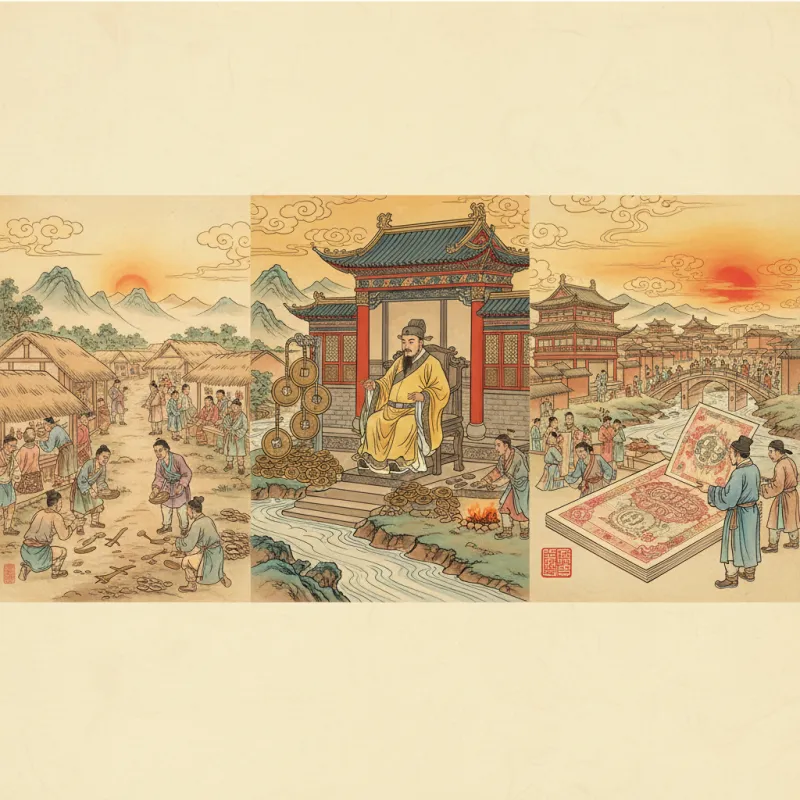
Ancient Chinese Currency: From Cowrie Shells to Paper Money
⏱️ 27 min read📅 Updated April 10, 2026⏱️ 27 min read📅 Updated April 10, 2026⏱️ 26 min read📅 Updated April 09, 2026Ancient Chinese Currency: From Cowrie Shells to Paper Money
The Dawn of Chinese Currency: Cowrie Shells and the Birth of Economic Exchange
Long before coins clinked in marketplaces or paper notes changed hands, ancient Chinese civilizations conducted trade using one of nature's most elegant currencies: cowrie shells (贝 bèi). These small, glossy shells, primarily from the Monetaria moneta species found in the warm waters of the Indian and Pacific Oceans, became China's first standardized medium of exchange during the Shang Dynasty (商朝 Shāng Cháo, c. 1600-1046 BCE).
The choice of cowrie shells was far from arbitrary. Their durability, portability, and inherent beauty made them ideal for trade. More importantly, their scarcity in inland China—requiring long-distance trade networks to obtain—gave them intrinsic value. Archaeological excavations at Yinxu (殷墟 Yīnxū), the last capital of the Shang Dynasty near modern Anyang, have uncovered thousands of cowrie shells in royal tombs, confirming their status as both currency and symbols of wealth.
The linguistic legacy of cowrie currency remains embedded in modern Chinese. The character 贝 (bèi) serves as the radical component in numerous characters related to wealth and commerce: 财 (cái, wealth), 货 (huò, goods), 贵 (guì, expensive), 贫 (pín, poor), and 赚 (zhuàn, to earn). This etymological fingerprint reveals how deeply cowrie shells influenced Chinese economic consciousness.
Bronze Age Innovation: Spade and Knife Money
As the Zhou Dynasty (周朝 Zhōu Cháo, 1046-256 BCE) emerged and bronze metallurgy advanced, China witnessed a revolutionary transformation in currency. The limitations of cowrie shells—their supply constraints and vulnerability to counterfeiting through imitation shells—necessitated innovation. The solution came in the form of bronze currencies shaped like everyday tools and weapons.
Spade money (布币 bù bì) emerged during the Spring and Autumn Period (春秋时期 Chūnqiū Shíqī, 770-476 BCE), taking its form from agricultural spades used for farming. These flat, spade-shaped bronze pieces featured a hollow socket at the top where a handle would traditionally fit, though currency versions were never intended for actual agricultural use. Various states produced their own versions, with inscriptions indicating their place of origin and sometimes their value. The State of Zhao (赵国 Zhào Guó), for instance, produced distinctive pointed-foot spade money, while the State of Wei (魏国 Wèi Guó) favored square-foot varieties.
Simultaneously, knife money (刀币 dāo bì) circulated primarily in the eastern coastal regions, particularly in the states of Qi (齐国 Qí Guó) and Yan (燕国 Yān Guó). These bronze pieces resembled miniature knives, complete with a ring at the handle end for stringing multiple pieces together. The most famous examples are the "Ming Dao" (明刀 míng dāo, bright knife) from Yan, which featured the character 明 prominently inscribed on the blade.
This period of diverse currencies reflected China's political fragmentation during the Warring States Period (战国时期 Zhànguó Shíqī, 475-221 BCE). Each state maintained its own monetary system, creating a complex economic landscape that both facilitated regional trade and complicated inter-state commerce.
The Round Coin Revolution: Ban Liang and the Qin Standardization
The unification of China under Qin Shi Huang (秦始皇 Qín Shǐ Huáng) in 221 BCE brought not only political consolidation but also monetary standardization. The First Emperor abolished the diverse currencies of the conquered states and mandated a single currency system: the ban liang (半两 bàn liǎng, half-tael) coin.
This innovation established the iconic design that would define Chinese coinage for over two millennia: a round bronze coin with a square hole in the center. This design, known as "round coin with square hole" (圆形方孔钱 yuánxíng fāngkǒng qián), embodied profound cosmological symbolism. The round shape represented heaven (天 tiān), while the square hole symbolized earth (地 dì), reflecting the ancient Chinese worldview of "round heaven and square earth" (天圆地方 tiān yuán dì fāng).
The practical advantages were equally significant. The square hole allowed coins to be strung together on cords, creating standardized strings of 1,000 coins called yiguan (一贯 yī guàn) or simply guan (贯 guàn). This system facilitated large transactions and accounting, as merchants could quickly count and transport substantial sums. The ban liang weighed approximately half a tael (两 liǎng), a traditional Chinese unit of weight equal to about 15.6 grams, though actual weights varied.
Han Dynasty Prosperity: Wu Zhu and Economic Expansion
The Han Dynasty (汉朝 Hàn Cháo, 206 BCE-220 CE) inherited and refined the Qin monetary system. Emperor Wu (汉武帝 Hàn Wǔdì, r. 141-87 BCE) introduced the wu zhu (五铢 wǔ zhū, five-zhu) coin in 118 BCE, which became one of history's longest-circulating currencies, remaining in production for over 700 years.
The wu zhu represented a masterpiece of monetary engineering. Weighing five zhu (approximately 3.25 grams), these coins featured the characters 五铢 inscribed on the obverse side. Their standardized weight and composition—typically 70% copper and 30% tin—made them difficult to counterfeit and easy to verify. The Han government established strict quality controls, with officials responsible for maintaining consistent standards across the empire's numerous mints.
The Silk Road (丝绸之路 Sīchóu Zhīlù), which flourished during the Han Dynasty, spread Chinese coins far beyond the empire's borders. Wu zhu coins have been discovered in archaeological sites across Central Asia, demonstrating the reach of Chinese economic influence. Foreign merchants and tributary states often adopted Chinese currency for trade, establishing the yuan (元 yuán) as an international medium of exchange centuries before modern globalization.
Tang Dynasty Sophistication: Kai Yuan Tong Bao and the Golden Age
The Tang Dynasty (唐朝 Táng Cháo, 618-907 CE) ushered in what many historians consider the golden age of Chinese civilization, and its monetary system reflected this sophistication. Emperor Gaozu (唐高祖 Táng Gāozǔ) introduced the kai yuan tong bao (开元通宝 kāi yuán tōng bǎo, "circulating treasure of the opening of a new era") in 621 CE, establishing a new naming convention for Chinese coins.
Unlike previous coins named for their weight, kai yuan tong bao introduced the "tong bao" (通宝 tōng bǎo, circulating treasure) designation, which subsequent dynasties would adopt. Each coin bore four characters arranged around the square hole: 开元 (kāi yuán) on top and bottom, 通宝 (tōng bǎo) on left and right. This design became the template for Chinese coinage through the end of the imperial era.
The Tang monetary system supported an unprecedented commercial revolution. Chang'an (长安 Cháng'ān, modern Xi'an), the Tang capital, became the world's largest city, with over one million inhabitants and merchants from across Asia, the Middle East, and beyond. The government operated multiple mints, producing millions of coins annually to meet the demands of this thriving economy.
However, the Tang Dynasty also witnessed the emergence of a problem that would plague Chinese monetary history: chronic copper shortages. As the economy expanded, demand for bronze coins outstripped the supply of copper. This scarcity led to several responses, including the use of iron coins in some regions and, most significantly, the development of paper money alternatives.
The Paper Money Revolution: Jiaozi and Flying Cash
The invention of paper money represents one of China's most consequential contributions to world civilization, and it emerged from practical necessity during the Song Dynasty (宋朝 Sòng Cháo, 960-1279 CE). The story begins in Sichuan Province (四川 Sìchuān), a region that used heavy iron coins due to copper scarcity, making large transactions physically burdensome.
Sichuan merchants developed the jiaozi (交子 jiāo zi, literally "exchange medium") around 1023 CE, initially as private promissory notes issued by deposit shops. Merchants would deposit their iron coins and receive paper certificates that could be redeemed later or transferred to others. These certificates, backed by the deposited coins, circulated as a form of representative money.
Recognizing both the innovation's utility and the potential for abuse, the Song government nationalized jiaozi production in 1024, establishing the world's first government-issued paper currency. The Bureau of Exchange Certificates (交子务 Jiāo Zi Wù) in Chengdu (成都 Chéngdū) printed these notes using sophisticated techniques including multiple colors, complex designs, and special seals to prevent counterfeiting.
Earlier, during the Tang Dynasty, the government had experimented with feiqian (飞钱 fēi qián, "flying cash"), a proto-paper money system. Merchants traveling to the capital could deposit coins and receive certificates redeemable in their home provinces, avoiding the dangers of transporting large sums. While not true currency—certificates were not transferable and could only be redeemed by the original depositor—flying cash demonstrated the government's willingness to innovate in monetary policy.
Yuan Dynasty Expansion: Chao and the Mongol Monetary Experiment
The Mongol conquest and establishment of the Yuan Dynasty (元朝 Yuán Cháo, 1271-1368) brought dramatic changes to Chinese monetary policy. Kublai Khan (忽必烈 Hūbìliè), the dynasty's founder, implemented an ambitious paper money system called chao (钞 chāo).
The Yuan government issued several types of paper currency, most notably the zhongtong yuanbao chao (中统元宝钞 zhōngtǒng yuánbǎo chāo) beginning in 1260. These notes were printed on mulberry bark paper, featured intricate designs, and came in various denominations. The government mandated their acceptance throughout the empire and prohibited the use of gold and silver for transactions, attempting to create a pure fiat currency system.
Marco Polo, the Venetian merchant who served in Kublai Khan's court, marveled at this system in his famous travelogue. He described how the Great Khan could "make his money" from tree bark and compel all subjects to accept it as payment. This account introduced Europeans to the concept of paper money, though they would not adopt it for several more centuries.
However, the Yuan paper money system ultimately failed due to excessive printing without adequate backing. As the government faced military expenses and administrative costs, it printed increasingly large quantities of chao, leading to severe inflation. By the late Yuan period, paper money had lost most of its value, contributing to the dynasty's economic instability and eventual collapse.
Ming and Qing Consolidation: Return to Metallic Standards
The Ming Dynasty (明朝 Míng Cháo, 1368-1644) initially attempted to continue paper currency with the da ming baochao (大明宝钞 dà míng bǎochāo, "Great Ming treasure note"), but memories of Yuan inflation made people reluctant to accept paper money. By the mid-15th century, the Ming government effectively abandoned paper currency, returning to a bimetallic system based on copper coins and silver ingots.
The silver tael (银两 yín liǎng) became the standard for large transactions, while copper cash continued for everyday purchases. This system, known as the "parallel standard" (银钱并用 yín qián bìng yòng), characterized Chinese monetary policy through the Qing Dynasty (清朝 Qīng Cháo, 1644-1912).
The Qing Dynasty produced copper coins inscribed with tongbao (通宝 tōng bǎo) or zhongbao (重宝 zhòng bǎo) along with the emperor's reign title. For example, coins from the Kangxi Emperor's reign (康熙 Kāngxī, r. 1661-1722) bore the inscription "Kangxi tongbao" (康熙通宝 Kāngxī tōng bǎo). The Qing government operated mints throughout the empire, with each mint adding identifying marks to its coins.
Legacy and Influence: China's Monetary Innovations in World History
Ancient Chinese currency innovations profoundly influenced global economic development. The concept of standardized coinage, the invention of paper money, and sophisticated monetary policies developed over millennia provided models that other civilizations would eventually adopt.
The round coin with square hole design spread throughout East Asia, with Japan, Korea, and Vietnam producing their own versions. Chinese characters on coins became a common feature across the region, creating a shared numismatic culture. The Japanese wadōkaichin (和同開珎), first minted in 708 CE, directly imitated Tang Dynasty coins.
Paper money, though initially abandoned in China after the Yuan Dynasty's inflationary disaster, eventually revolutionized global commerce. When European nations adopted paper currency in the 17th and 18th centuries, they built upon principles first developed in Song Dynasty China seven centuries earlier.
The Chinese monetary tradition also established important precedents in government economic policy. The concept of state monopoly over currency production, quality control standards, and the use of monetary policy as a tool of governance all originated in ancient China. These principles remain fundamental to modern central banking.
Conclusion: The Enduring Wisdom of Ancient Chinese Monetary Systems
From cowrie shells to paper money, ancient Chinese currency evolved over three millennia, reflecting the civilization's economic sophistication, technological innovation, and philosophical depth. Each monetary form—whether bronze spades, round coins, or printed notes—embodied both practical solutions to economic challenges and deeper cultural values.
The journey from 贝 (bèi) to 钞 (chāo) demonstrates how Chinese civilization continuously adapted its monetary systems to meet changing needs while maintaining core principles of standardization, quality, and government oversight. Modern China's economic rise and the internationalization of the renminbi (人民币 rénmínbì) continue this ancient tradition of monetary innovation, connecting contemporary financial systems to practices developed thousands of years ago in the markets of Shang Dynasty cities and the counting houses of Tang Dynasty merchants.
About the Author
Dynasty Scholar — A specialist in economy and Chinese cultural studies.
Related Articles
The Grand Canal: China Greatest Infrastructure Project
China Greatest Infrastructure Project...
The Salt Monopoly: How Salt Shaped Chinese Imperial Power
How Salt Shaped Chinese Imperial Power...
The Song Dynasty Economy: The World First Modern Economy
The World First Modern Economy...
Unraveling the Economic Tapestry of Ancient Chinese Dynasties
Explore the economic foundations of ancient China and its influence on culture and society through the dynasties....