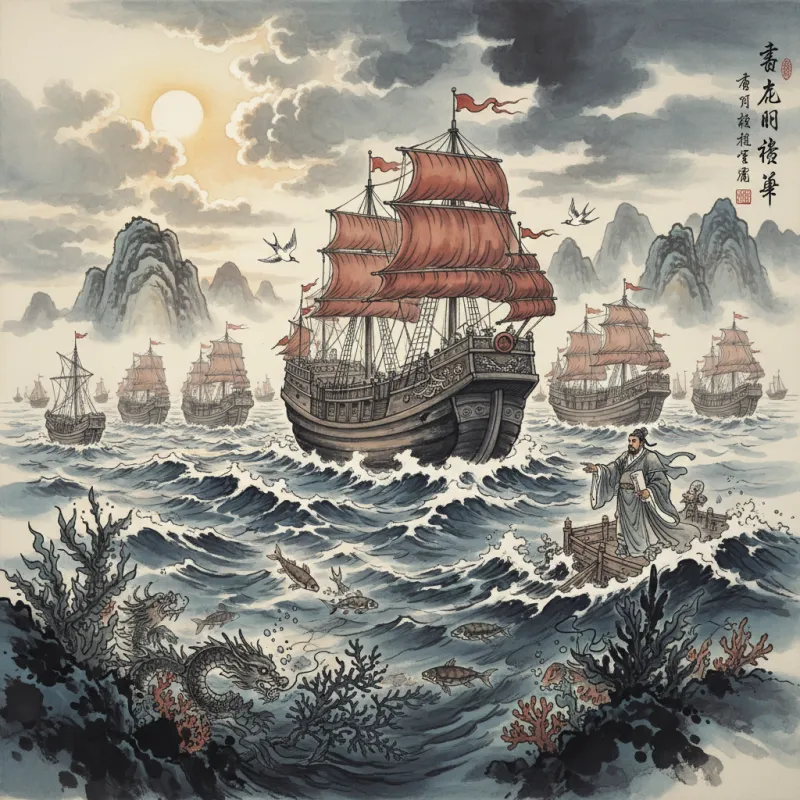
Zheng He Voyages: China Age of Maritime Exploration
⏱️ 27 min read📅 Updated April 10, 2026⏱️ 27 min read📅 Updated April 10, 2026⏱️ 26 min read📅 Updated April 09, 2026Zheng He's Voyages: China's Age of Maritime Exploration
The Admiral Who Commanded the Treasure Fleet
Between 1405 and 1433, the Ming Dynasty (明朝, Míng Cháo) launched one of history's most ambitious maritime expeditions. At the helm stood Zheng He (鄭和, Zhèng Hé), a Muslim eunuch admiral who commanded fleets that dwarfed anything Europe would produce for another century. His seven voyages across the Indian Ocean represented not conquest, but a sophisticated exercise in diplomatic power projection that showcased China's technological supremacy and cultural confidence during the early 15th century.
Zheng He's treasure ships, or baochuan (寶船, bǎochuán), were engineering marvels. Historical records suggest the largest vessels measured approximately 400 feet in length—though modern scholars debate these dimensions, even conservative estimates place them at roughly 200-250 feet, still massive compared to Columbus's Santa Maria, which was a mere 85 feet. These floating palaces featured nine masts, watertight compartments, and luxurious accommodations for diplomats and officials. The fleets themselves comprised over 200 vessels carrying nearly 28,000 men, including sailors, soldiers, physicians, astronomers, translators, and craftsmen.
The Man Behind the Mission
Born Ma He (馬和, Mǎ Hé) around 1371 in Yunnan province to a Muslim family, Zheng He's path to naval command was anything but conventional. Captured as a boy during Ming military campaigns, he was castrated and entered imperial service as a eunuch. His intelligence and military acumen caught the attention of Prince Zhu Di, who would later become the Yongle Emperor (永樂帝, Yǒnglè Dì). When Zhu Di seized the throne in 1402, he elevated his loyal servant, bestowing upon him the surname Zheng and the title of Grand Eunuch.
The Yongle Emperor's motivations for launching these expeditions were multifaceted. Officially, the voyages aimed to extend the tianxia (天下, tiānxià)—the concept of "all under heaven"—by bringing distant kingdoms into China's tributary system. The emperor sought to establish China as the undisputed center of the civilized world, with foreign rulers acknowledging Ming supremacy through tribute missions. Some historians suggest Yongle also hoped to locate his deposed nephew, the Jianwen Emperor, rumored to have fled overseas. Additionally, the voyages served to suppress piracy, establish trade networks, and demonstrate Ming power after the dynasty's tumultuous founding.
The Seven Expeditions: Reaching the Known World
The First Voyage (1405-1407): Establishing Presence
Zheng He's inaugural expedition departed from Nanjing in 1405, sailing down the Chinese coast to Champa (modern-day Vietnam), then across to Java, Sumatra, and Ceylon (Sri Lanka), before reaching Calicut on India's Malabar Coast. This voyage established the basic route and diplomatic protocols that subsequent expeditions would follow. The fleet carried silk, porcelain, and other luxury goods as gifts for foreign rulers, demonstrating China's wealth and manufacturing prowess.
At each port, Zheng He presented imperial edicts and bestowed titles upon local rulers who agreed to send tribute to the Ming court. The Chinese concept of chaogong (朝貢, cháogòng), or tributary relations, differed fundamentally from European colonialism. Rather than extracting resources or establishing permanent settlements, the Ming sought acknowledgment of their cultural and political superiority. Foreign rulers who participated received generous gifts often exceeding the value of their tribute, along with trading privileges and imperial recognition.
The Second and Third Voyages (1407-1411): Expanding the Network
The second and third voyages followed similar routes but extended China's diplomatic reach. Zheng He visited Siam (Thailand), Cochin, and numerous ports along the Indian coast. During the third voyage, the fleet intervened in a succession dispute in Ceylon, capturing the hostile King Alakeshvara and bringing him to Nanjing. This demonstrated that Ming power could enforce order even in distant lands, though the Chinese quickly installed a more cooperative ruler and withdrew, showing no interest in permanent occupation.
These expeditions also served scientific purposes. The fleet included astronomers who made celestial observations, cartographers who created detailed maps, and naturalists who documented foreign flora and fauna. The Mao Kun Map (茅坤圖, Máo Kūn Tú), preserved in the Wubei Zhi (武備志, Wǔbèi Zhì) military treatise, shows the sophisticated navigational knowledge accumulated during these voyages, including compass bearings, coastal profiles, and depth soundings.
The Fourth Through Sixth Voyages (1413-1422): Reaching Africa
The fourth voyage marked a significant expansion, with the fleet reaching Hormuz at the entrance to the Persian Gulf and multiple ports along the Arabian Peninsula. More remarkably, Chinese ships reached the East African coast, visiting Mogadishu, Malindi, and other Swahili city-states. These voyages brought back exotic animals including giraffes, which caused sensations at the Ming court. The giraffe was identified as a qilin (麒麟, qílín), a mythical creature whose appearance signified the virtue of the ruler—perfect propaganda for the Yongle Emperor's legitimacy.
The fifth and sixth voyages continued this pattern, with the fleet returning with envoys from over thirty kingdoms. The Yongle Emperor received these foreign dignitaries in elaborate ceremonies at the Forbidden City (紫禁城, Zǐjìnchéng), showcasing Ming grandeur. These tributary missions brought not just exotic goods but also knowledge—information about foreign customs, geography, and political situations that enriched Chinese understanding of the wider world.
The Seventh and Final Voyage (1431-1433): The Swan Song
After the Yongle Emperor's death in 1424, the treasure voyages faced increasing opposition from Confucian officials who viewed them as wasteful extravagances. The Hongxi Emperor suspended the expeditions, but his successor, the Xuande Emperor (宣德帝, Xuāndé Dì), authorized one final voyage in 1431. This seventh expedition revisited familiar ports and reached as far as Jeddah on the Red Sea, bringing the fleet within reach of Mecca and the Mediterranean world.
Zheng He died during or shortly after this final voyage, likely in 1433. With his passing, China's age of maritime exploration effectively ended. The treasure fleet was decommissioned, and subsequent Ming emperors turned their attention inward, eventually implementing policies that restricted maritime trade and shipbuilding.
Technology and Innovation: The Foundation of Success
The treasure voyages were possible only because of China's advanced maritime technology. Chinese shipbuilders had developed watertight compartments centuries before European adoption of this crucial safety feature. The sternpost rudder, another Chinese innovation, provided superior steering compared to the steering oars used in the West. Multiple masts with battened sails allowed for better sail management and the ability to sail closer to the wind.
Navigation relied on the magnetic compass, a Chinese invention, combined with detailed rutters (航海指南, hánghaǐ zhǐnán)—written sailing directions that described routes, landmarks, and hazards. Chinese navigators used a system of measuring distance by geng (更, gēng), watches of approximately 2.4 hours, combined with speed estimation. They also practiced celestial navigation, measuring the altitude of stars above the horizon using their fingers as rough angle measurements.
The logistics of supporting such massive fleets required sophisticated organization. The Ming established shipyards at Nanjing capable of constructing hundreds of vessels simultaneously. Supply depots along the Chinese coast stockpiled provisions. The fleet carried its own food production capacity, including livestock and even soil for growing vegetables aboard ship. This logistical infrastructure represented a massive state investment that only a wealthy, centralized empire could sustain.
Diplomacy Without Conquest: The Chinese Approach
What distinguished Zheng He's voyages from later European exploration was their fundamentally diplomatic rather than colonial character. The treasure fleets carried soldiers and could project military force when necessary—as demonstrated in Ceylon and against pirates—but conquest and permanent occupation were never objectives. Instead, the voyages aimed to incorporate foreign kingdoms into China's tributary system, a hierarchical but mutually beneficial arrangement.
The tributary system reflected Confucian concepts of hierarchical order and proper relationships. Just as sons owed filial piety to fathers and subjects loyalty to rulers, foreign kingdoms should acknowledge the Chinese emperor's supremacy. In return, they received protection, trading privileges, and valuable gifts. The system was more symbolic than exploitative; tribute missions often cost the Ming treasury more than they generated in revenue. The real value lay in affirming China's central position in the world order.
This approach reflected Chinese cultural confidence. The Ming saw themselves as the inheritors of thousands of years of civilization, possessing superior technology, philosophy, and governance. They had no need to conquer "barbarian" lands or extract their resources. Foreign peoples would naturally gravitate toward Chinese civilization once exposed to its superiority—or so the thinking went. This attitude, while ethnocentric, produced a less destructive form of imperialism than the European colonialism that would follow.
The Abrupt End: Why China Turned Inward
The cessation of the treasure voyages after 1433 remains one of history's great counterfactuals. Had China continued its maritime expansion, the Age of Exploration might have unfolded very differently. Several factors contributed to this dramatic policy reversal.
Confucian officials at court had always opposed the voyages as wasteful and contrary to proper priorities. Confucianism emphasized agriculture as the foundation of society and viewed merchants and maritime trade with suspicion. The shi-nong-gong-shang (士農工商, shì-nóng-gōng-shāng) social hierarchy placed scholars at the top and merchants at the bottom. Spending vast sums on naval expeditions violated Confucian principles of frugality and proper resource allocation.
The Yongle Emperor's death removed the voyages' primary patron. His successors faced more pressing concerns, particularly the Mongol threat on the northern frontier. The Ming invested heavily in rebuilding and extending the Great Wall (長城, Chángchéng), a defensive project that consumed resources that might otherwise have funded maritime expeditions. The capital's relocation from Nanjing back to Beijing in 1421 also shifted imperial attention northward.
Economic factors played a role as well. The voyages were enormously expensive, and their economic returns were questionable. While they facilitated trade, the tributary system's gift-giving requirements meant the court often lost money on these exchanges. As fiscal pressures mounted, the voyages became increasingly difficult to justify.
Perhaps most significantly, the voyages had achieved their primary objective: establishing China's prestige and bringing numerous kingdoms into the tributary system. With this accomplished, continuing the expeditions seemed unnecessary. The Ming court's lack of interest in territorial expansion or resource extraction meant they saw no reason to maintain a permanent naval presence in the Indian Ocean.
Legacy and Historical Significance
Zheng He's voyages represent a remarkable achievement in maritime history, yet their impact proved surprisingly limited. Unlike European exploration, which led to colonization, cultural exchange, and lasting global transformation, the treasure voyages left few permanent traces outside China. The Ming destroyed many records of the expeditions, and subsequent Chinese dynasties showed little interest in maritime expansion.
Within China, Zheng He became a folk hero, particularly among Chinese Muslims who took pride in his achievements. Temples dedicated to him appeared in coastal regions, and his voyages inspired legends and stories. However, official histories often downplayed or ignored the expeditions, reflecting the Confucian establishment's disapproval of such ventures.
Modern China has rediscovered Zheng He as a symbol of Chinese achievement and peaceful international engagement. The voyages are cited as evidence of China's historical commitment to trade and diplomacy rather than conquest—a contrast to Western colonialism. This interpretation serves contemporary Chinese foreign policy narratives, particularly regarding the Belt and Road Initiative, which Chinese officials sometimes describe as following Zheng He's peaceful, mutually beneficial approach to international relations.
Historians continue debating the voyages' significance. Some see them as a missed opportunity—had China maintained its maritime presence, it might have dominated global trade and prevented European colonial expansion. Others argue this view is anachronistic, imposing modern values and objectives onto a civilization with fundamentally different priorities. The Ming had no interest in the kind of territorial empire Europeans would build; their goals were diplomatic and symbolic rather than economic or colonial.
Conclusion: A Different Path Not Taken
Zheng He's treasure voyages illuminate a moment when China possessed the technological capability and resources to dominate the seas, yet chose not to pursue maritime empire. This decision reflected deep-seated cultural values that prioritized internal harmony, agricultural productivity, and Confucian virtue over external expansion and commercial gain. The voyages demonstrated Chinese power and sophistication, but their cessation revealed the limits of that power's application.
The contrast with European exploration, which began just decades after Zheng He's final voyage, could not be starker. Where Chinese fleets sought tribute and acknowledgment, European ships sought gold, territory, and converts. Where China turned inward after achieving its diplomatic objectives, Europe turned outward, driven by commercial competition and religious zeal. These different approaches would shape the modern world, with consequences still unfolding today.
Zheng He remains a fascinating figure—a Muslim eunuch who commanded history's greatest pre-modern fleet, a diplomat who projected power without conquest, and a symbol of roads not taken in human history. His voyages remind us that technological capability does not determine historical outcomes; cultural values, political priorities, and individual choices matter just as much. In an era when China again projects power globally, Zheng He's legacy offers both inspiration and cautionary lessons about the relationship between capability and ambition, between power and its exercise.
About the Author
Dynasty Scholar — A specialist in diplomacy and Chinese cultural studies.
Related Articles
The Great Wall as Diplomacy: Defense Trade and Exchange
Defense Trade and Exchange...
Silk Road Diplomacy: How Trade Routes Shaped Foreign Policy
How Trade Routes Shaped Foreign Policy...
The Tribute System: How China Managed International Relations
How China Managed International Relations...
Diplomacy and Cultural Exchange in Chinese Ancient Dynasties
Explore the rich tapestry of diplomacy and cultural exchange throughout ancient Chinese history....