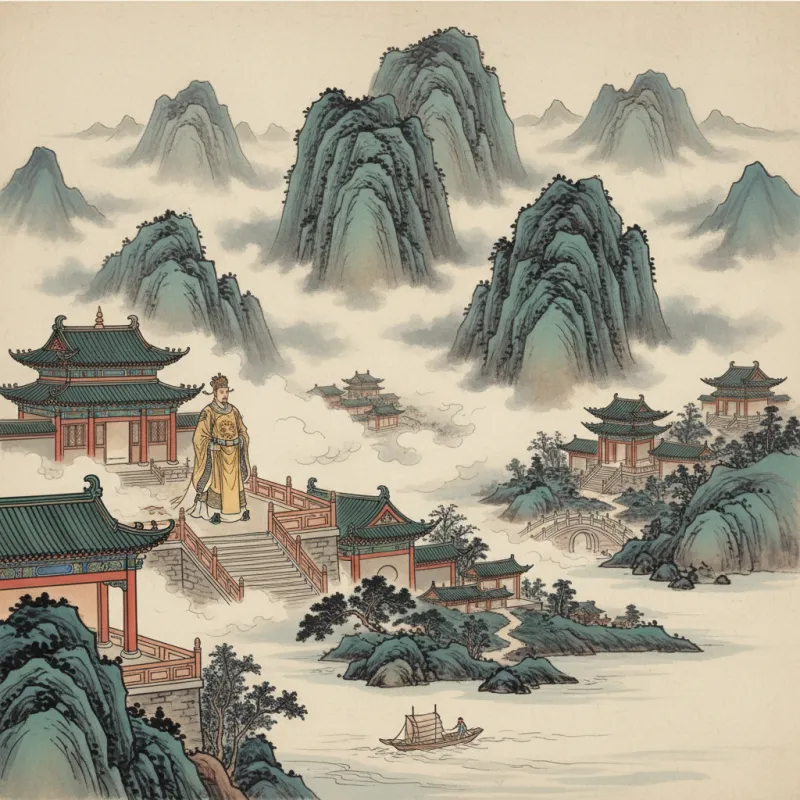
Chinese Painting Traditions: From Landscapes to Court Portraits
⏱️ 23 min read📅 Updated April 10, 2026⏱️ 23 min read📅 Updated April 10, 2026⏱️ 22 min read📅 Updated April 09, 2026Chinese Painting Traditions: From Landscapes to Court Portraits
Chinese painting represents one of the world's oldest continuous artistic traditions, spanning over two millennia of creative expression. Unlike Western painting, which historically emphasized realistic representation and perspective, Chinese painting developed as a philosophical and spiritual practice deeply intertwined with calligraphy, poetry, and the literati culture. From the misty mountain landscapes of the Song dynasty to the meticulously detailed court portraits of the Qing, Chinese painting traditions reveal the evolving values, aesthetics, and social structures of imperial China.
The Philosophical Foundations of Chinese Painting
Chinese painting cannot be understood without grasping its philosophical underpinnings. The art form emerged from a worldview shaped by Confucianism, Daoism, and Buddhism, each contributing distinct elements to artistic theory and practice.
The concept of qiyun shengdong (氣韻生動, qìyùn shēngdòng) or "spirit resonance and life movement" became the paramount criterion for judging painting quality. First articulated by the 5th-century art critic Xie He in his "Six Principles of Painting," this principle emphasized capturing the essential spirit or vital energy of the subject rather than mere physical likeness. A painter who could convey the qi (氣, qì) or vital force of a bamboo stalk or mountain peak was considered superior to one who merely reproduced its external appearance.
Daoist philosophy particularly influenced landscape painting, encouraging artists to see nature as a manifestation of the Dao (道, dào) - the fundamental principle underlying the universe. The Daoist ideal of harmony between humanity and nature led painters to depict humans as small figures within vast landscapes, emphasizing the cosmic perspective rather than human dominance. This contrasts sharply with Western landscape traditions, where human subjects often occupy central positions.
The Materials and Techniques: Brush, Ink, and Silk
Chinese painting developed unique materials and techniques that shaped its distinctive aesthetic. The "Four Treasures of the Study" (wenfang sibao, 文房四寶, wénfáng sìbǎo) - brush, ink, paper, and inkstone - were the painter's essential tools.
The Chinese brush, with its flexible animal-hair tip, allowed for extraordinary variation in line quality. A single brushstroke could transition from thick to thin, dark to light, creating what the Chinese called cun (皴, cūn) - texture strokes that suggested the surface quality of rocks, tree bark, or mountain faces. Masters developed dozens of cun techniques, each with evocative names like "axe-cut strokes" (fupi cun, 斧劈皴, fǔpī cūn) or "hemp-fiber strokes" (pima cun, 披麻皴, pīmá cūn).
Ink, traditionally made from pine soot mixed with animal glue, could be diluted to produce gradations from deep black to pale gray. This range, called the "five colors of ink" (mo fen wu se, 墨分五色, mò fēn wǔ sè), allowed painters to create depth, atmosphere, and tonal variation using only monochrome ink. The technique of pocai (潑彩, pōcǎi) or "splashed color" involved applying diluted ink or color washes to create atmospheric effects.
Early paintings were executed on silk, which provided a smooth, luminous surface. By the Tang dynasty (618-907 CE), paper became increasingly popular, offering a more absorbent surface that created different textural effects. The choice between silk and paper significantly influenced painting style and technique.
Landscape Painting: Mountains and Waters
Shanshui (山水, shānshuǐ) painting - literally "mountain-water" painting - emerged as the most prestigious genre in Chinese art. Unlike Western landscape painting, which developed relatively late, Chinese landscape painting achieved philosophical and technical maturity by the 10th century.
The Northern Song dynasty (960-1127) produced some of China's greatest landscape masters. Painters like Fan Kuan (范寬, Fàn Kuān) created monumental compositions featuring towering mountains that filled the picture plane. His masterpiece "Travelers Among Mountains and Streams" exemplifies the "high-distance" (gaoyuan, 高遠, gāoyuǎn) perspective, where the viewer looks upward at imposing peaks that seem to touch the heavens. The tiny human figures - travelers with pack mules dwarfed by massive cliffs - emphasize nature's grandeur and humanity's humble place within it.
Guo Xi (郭熙, Guō Xī), another Northern Song master, articulated the "three distances" (san yuan, 三遠, sān yuǎn) theory in his treatise "The Lofty Message of Forests and Streams." Beyond high-distance, he identified "deep-distance" (shenyuan, 深遠, shēnyuǎn), looking from foreground into far depths, and "level-distance" (pingyuan, 平遠, píngyuǎn), viewing across horizontal expanses. These perspectives allowed painters to create complex spatial relationships without Western linear perspective.
The Southern Song dynasty (1127-1279) saw a shift toward more intimate, poetic landscapes. Ma Yuan (馬遠, Mǎ Yuǎn) and Xia Gui (夏圭, Xià Guī) pioneered the "one-corner" composition, where elements occupied only a portion of the silk, leaving vast areas of empty space. This use of liubai (留白, liúbái) or "leaving blank" created atmospheric effects suggesting mist, distance, or the void itself - a visual manifestation of Daoist emptiness.
The Literati Tradition: Painting as Self-Expression
The wenrenhua (文人畫, wénrénhuà) or "literati painting" tradition transformed Chinese art during the Yuan dynasty (1271-1368). When Mongol conquest ended Song rule, many educated Chinese scholars refused to serve the foreign dynasty, retreating into private life. These literati painters rejected the detailed, decorative court style, instead emphasizing personal expression, calligraphic brushwork, and amateur ideals.
Zhao Mengfu (趙孟頫, Zhào Mèngfǔ), though he controversially served the Yuan court, pioneered the literati aesthetic by reviving ancient styles and emphasizing the connection between painting and calligraphy. His famous statement that "rocks should be painted like flying-white calligraphy" established the principle that brushwork quality mattered more than representational accuracy.
The "Four Great Masters of the Yuan" - Huang Gongwang (黃公望, Huáng Gōngwàng), Wu Zhen (吳鎮, Wú Zhèn), Ni Zan (倪瓚, Ní Zàn), and Wang Meng (王蒙, Wáng Méng) - each developed distinctive styles that influenced centuries of subsequent painting. Ni Zan's sparse, austere landscapes with their characteristic composition of foreground trees, middle-ground water, and distant mountains became an enduring model. His deliberate rejection of color and decorative elements expressed the literati ideal of pingdan (平淡, píngdàn) or "blandness" - a refined simplicity that revealed depth through restraint.
The Ming dynasty (1368-1644) saw the literati tradition flourish. The "Four Masters of the Ming" continued developing individualistic styles, while theoretical writings codified literati principles. Dong Qichang (董其昌, Dǒng Qíchāng), the influential late-Ming painter and theorist, divided Chinese painting history into "Northern" and "Southern" schools - not geographic designations but stylistic categories. The "Southern school" of literati painting, emphasizing spontaneity and personal expression, was deemed superior to the "Northern school" of professional, decorative painting.
Bird-and-Flower Painting: Nature in Microcosm
Huaniaohua (花鳥畫, huāniǎohuà) or bird-and-flower painting constituted another major genre. These works depicted plants, birds, insects, and small animals, often imbued with symbolic meanings drawn from Chinese literature and folklore.
Two approaches dominated the genre. The gongbi (工筆, gōngbǐ) or "meticulous brush" style featured precise, detailed rendering with fine lines and careful color application. Court painters particularly favored this approach, creating works of stunning technical virtuosity. The Song emperor Huizong (徽宗, Huīzōng, r. 1100-1126), himself an accomplished painter, established an imperial painting academy that produced exquisite gongbi works. His own painting "Finches and Bamboo" demonstrates the style's characteristic precision, with each feather individually delineated.
The contrasting xieyi (寫意, xiěyì) or "freehand" style emphasized spontaneous, expressive brushwork over detailed representation. Literati painters particularly embraced this approach, using bold, abbreviated strokes to capture essential characteristics. The "Four Gentlemen" (sijunzi, 四君子, sì jūnzǐ) - plum blossom, orchid, bamboo, and chrysanthemum - became favorite xieyi subjects, each symbolizing noble qualities. Bamboo painting, in particular, became a literati specialty, with the plant's resilient, upright character serving as a metaphor for the scholar's integrity.
Court Portraiture: Capturing Imperial Majesty
Portrait painting (renwuhua, 人物畫, rénwùhuà) in China served primarily ceremonial and commemorative functions rather than the psychological exploration characteristic of Western portraiture. Court portraits of emperors and empresses followed strict conventions designed to convey authority, legitimacy, and cosmic order.
Imperial portraits typically showed the subject in formal, frontal pose, seated on a throne and wearing elaborate ceremonial robes. The gunfu (袞服, gǔnfú) or dragon robes worn by emperors featured intricate symbolism - five-clawed dragons representing imperial power, the twelve symbols of sovereignty, and cosmological motifs connecting the ruler to heaven and earth. These portraits emphasized the emperor's role as the "Son of Heaven" (tianzi, 天子, tiānzǐ) rather than individual personality.
The Qing dynasty (1644-1911) produced particularly impressive court portraits. The Kangxi Emperor (康熙, Kāngxī, r. 1661-1722) and Qianlong Emperor (乾隆, Qiánlóng, r. 1735-1796) commissioned numerous portraits showing themselves in various roles - as Confucian sage, Buddhist bodhisattva, or Manchu warrior. These multiple representations reinforced their legitimacy to rule China's diverse population.
Jesuit missionaries at the Qing court introduced Western painting techniques, including chiaroscuro and linear perspective. Court painter Giuseppe Castiglione (Chinese name Lang Shining, 郎世寧, Láng Shìníng) synthesized Chinese and Western approaches, creating a hybrid style that combined Chinese materials and composition with Western modeling and spatial depth. His portraits of the Qianlong Emperor and imperial horses demonstrate this successful fusion.
Portraits of officials and scholars followed different conventions. xingxiang (行像, xíngxiàng) or "traveling portraits" showed subjects in informal settings, often surrounded by symbolic objects revealing their interests and accomplishments. Ancestor portraits, commissioned for family shrines, maintained more rigid frontal poses to facilitate ritual veneration.
The Role of Seals and Inscriptions
Chinese paintings were rarely considered complete without tiba (題跋, tíbà) - inscriptions and colophons added by the artist, owners, or later connoisseurs. These inscriptions, written in calligraphy, might include poems, comments on the painting's meaning or technique, or records of ownership. The practice transformed paintings into collaborative works spanning generations, with each inscription adding layers of meaning and historical context.
Red seals (yinzhang, 印章, yìnzhāng) served multiple functions. The artist's seal authenticated the work, while collectors' seals recorded provenance. Imperial seals indicated works in the palace collection. Some famous paintings accumulated dozens of seals over centuries, creating a visual record of their journey through history. The Qianlong Emperor was particularly enthusiastic about adding his seals and inscriptions to paintings in the imperial collection, sometimes controversially covering portions of the original work.
Legacy and Continuity
Chinese painting traditions demonstrated remarkable continuity while accommodating innovation. Each generation of painters studied ancient masters, copying their works to internalize techniques and principles. This practice of linmo (臨摹, línmó) or copying was not mere imitation but a method of transmission and creative engagement with tradition.
The fall of the Qing dynasty in 1911 and the subsequent tumultuous 20th century challenged these traditions. Some artists embraced Western techniques and modernist approaches, while others sought to preserve and revitalize traditional methods. Today, Chinese painting traditions continue evolving, with contemporary artists drawing on this rich heritage while addressing modern concerns.
From the philosophical depths of literati landscapes to the ceremonial grandeur of court portraits, Chinese painting traditions offer a window into the values, aesthetics, and worldview of imperial China. The emphasis on brushwork quality, the integration of painting with calligraphy and poetry, and the preference for suggestion over explicit representation created an artistic language distinctly different from Western traditions yet equally sophisticated and profound. Understanding these traditions enriches our appreciation not only of Chinese art but of the diverse ways human cultures have sought to capture and express their experience of the world.
About the Author
Dynasty Scholar — A specialist in art and Chinese cultural studies.
Related Articles
Chinese Calligraphy: The Art That Shaped a Civilization
The Art That Shaped a Civilization...
Chinese Ceramics and Porcelain: A History of Innovation
A History of Innovation...
Jade Carving in Chinese History: The Stone of Virtue
The Stone of Virtue...
Delving into Ancient China: A Journey Through Dynasties, Emperors, and Cultural Treasures
Explore the rich tapestry of ancient Chinese history, from powerful dynasties to remarkable cultural achievements....