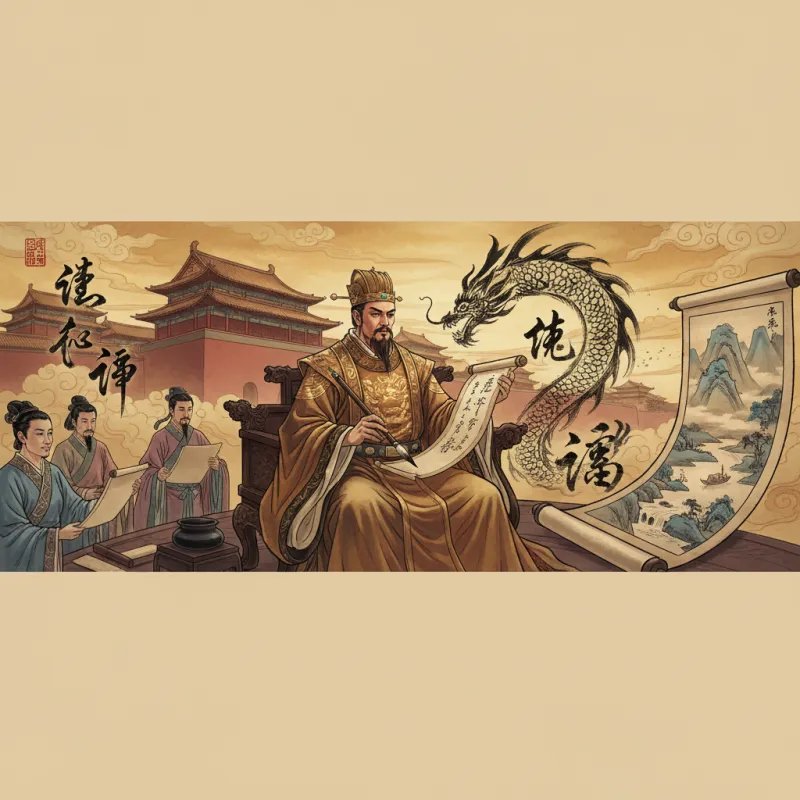
Chinese Calligraphy: The Art That Shaped a Civilization
⏱️ 21 min read📅 Updated April 10, 2026⏱️ 21 min read📅 Updated April 10, 2026⏱️ 20 min read📅 Updated April 09, 2026Chinese Calligraphy: The Art That Shaped a Civilization
The Brush as Sword: Understanding China's Supreme Art
In the pantheon of Chinese cultural achievements, calligraphy—書法 (shūfǎ, literally "the method of writing")—stands alone as the most revered art form. While Western civilization elevated painting and sculpture to the highest aesthetic ranks, China placed the written word above all else. This wasn't merely about communication; it was about capturing the essence of cosmic energy, revealing character, and achieving immortality through ink.
The Tang Dynasty poet and calligrapher Sun Guoting (孫過庭) wrote in his treatise Treatise on Calligraphy (書譜, Shūpǔ): "Calligraphy is a manifestation of the spirit." This single statement encapsulates why emperors, scholars, and monks devoted lifetimes to perfecting their brushwork. The quality of one's calligraphy was considered a direct window into one's moral character, education, and spiritual cultivation.
The Four Treasures: Tools of Transformation
Before understanding calligraphy's profound impact, one must know the 文房四寶 (wénfáng sìbǎo)—the "Four Treasures of the Study." These weren't mere tools but sacred implements:
The Brush (筆, bǐ): Made from animal hair—wolf, rabbit, goat, or weasel—mounted on bamboo or more precious materials. The brush's flexibility allowed for the infinite variation in line thickness and texture that defines Chinese calligraphy. Master brushmakers were celebrated artisans, and certain historical brushes became treasured relics.
The Ink (墨, mò): Traditionally made from pine soot or oil soot mixed with animal glue, formed into solid ink sticks often decorated with gold and carved designs. The calligrapher would grind the stick on an ink stone with water, a meditative process that prepared both the medium and the mind.
The Paper (紙, zhǐ): After Cai Lun (蔡倫) revolutionized papermaking during the Eastern Han Dynasty (25-220 CE), paper became the primary surface for calligraphy. Xuan paper (宣紙, xuānzhǐ) from Anhui Province, with its ability to absorb and diffuse ink in subtle gradations, became the gold standard.
The Ink Stone (硯, yàn): Carved from special stone, these grinding surfaces were prized for their texture and ability to produce smooth, rich ink. Duan stones (端硯, duānyàn) from Guangdong were particularly treasured, sometimes worth more than jade.
The Evolution of Scripts: A Journey Through Time
Chinese calligraphy's history mirrors China's own transformation, with each script style reflecting the aesthetic and philosophical concerns of its era.
Oracle Bone Script (甲骨文, jiǎgǔwén)
The earliest Chinese writing, carved on turtle shells and ox bones during the Shang Dynasty (1600-1046 BCE), was already remarkably sophisticated. These divination records show a writing system with thousands of characters, many recognizable today. The angular, pictographic forms were dictated by the carving process, yet they possessed an austere beauty that modern calligraphers still study.
Seal Script (篆書, zhuànshū)
Standardized during the Qin Dynasty (221-206 BCE) by Prime Minister Li Si (李斯), seal script represented the first empire-wide writing standard. Its rounded, symmetrical forms appeared on official seals, bronze inscriptions, and stone monuments. The famous Stone Drums (石鼓文, Shígǔwén) exemplify this style's archaic elegance. Even today, seal script remains essential for official seals and formal inscriptions.
Clerical Script (隸書, lìshū)
Emerging during the Han Dynasty (206 BCE-220 CE), clerical script marked a revolutionary shift toward efficiency and practicality. Its flattened, broader strokes with distinctive "silkworm head and wild goose tail" (蠶頭雁尾, cántóu yànwěi) endings made writing faster while maintaining aesthetic appeal. The Han Dynasty stone classics carved in clerical script at the Imperial Academy became models studied for centuries.
Regular Script (楷書, kǎishū)
Perfected during the Tang Dynasty (618-907 CE), regular script became the standard for printed and handwritten Chinese. Its balanced, clear structure made it ideal for both artistic expression and practical use. The "Four Masters of Regular Script"—Ouyang Xun (歐陽詢), Yan Zhenqing (顏真卿), Liu Gongquan (柳公權), and Zhao Mengfu (趙孟頫)—each developed distinctive styles that calligraphers still emulate today.
Yan Zhenqing's powerful, muscular strokes embodied Confucian rectitude and moral strength. His Manuscript of Requiem to My Nephew (祭姪文稿, Jì Zhí Wéngǎo), written in grief after his nephew's death during the An Lushan Rebellion, is considered one of the three greatest calligraphic works in Chinese history. The raw emotion visible in the increasingly wild brushwork demonstrates how calligraphy could capture psychological states.
Running Script (行書, xíngshū)
A semi-cursive style balancing legibility and artistic freedom, running script became the preferred mode for personal correspondence and literary works. Wang Xizhi (王羲之, 303-361 CE), the "Sage of Calligraphy," achieved immortal fame with his Preface to the Poems Composed at the Orchid Pavilion (蘭亭集序, Lántíng Jí Xù). Written in 353 CE during a gathering of poets, this masterpiece's effortless grace and perfect balance made it the most copied work in Chinese history. Emperor Taizong of Tang loved it so much he was reportedly buried with the original.
Cursive Script (草書, cǎoshū)
The most abstract and expressive style, cursive script allowed calligraphers to achieve pure artistic freedom. Characters flow together in continuous motion, sometimes barely recognizable. Zhang Xu (張旭) of the Tang Dynasty, known as the "Sage of Cursive Script," would allegedly write while drunk, his wild, dancing characters embodying spontaneous creativity. This "wild cursive" (狂草, kuángcǎo) pushed calligraphy toward pure abstraction, anticipating modern art by a millennium.
Calligraphy and Power: The Imperial Connection
Chinese emperors understood that calligraphy was political power. Imperial edicts gained authority not just from their content but from the emperor's calligraphic hand. The Qianlong Emperor (乾隆帝, r. 1735-1796) was a prolific calligrapher who inscribed his work on countless paintings and artifacts, literally writing himself into China's cultural heritage.
The civil service examination system (科舉, kējǔ), which selected government officials for over 1,300 years, required excellent calligraphy. Candidates spent years perfecting their 館閣體 (guǎngétǐ)—the "academy style"—a rigorous, standardized regular script. Poor handwriting could doom even the most brilliant essay. This system ensured that China's ruling class shared not just Confucian values but aesthetic standards, creating remarkable cultural continuity.
The Philosophical Foundations: Qi, Dao, and the Dancing Brush
Chinese calligraphy is inseparable from Chinese philosophy. The concept of 氣 (qì)—vital energy or life force—permeates calligraphic theory. A work's 氣韻 (qìyùn, "spirit resonance") determines its quality. Calligraphers cultivated qi through meditation, breathing exercises, and moral cultivation, believing that inner harmony manifested in brushwork.
The Daoist principle of 無為 (wúwéi, "effortless action") influenced calligraphic practice. The greatest works appeared spontaneous and natural, though they resulted from decades of discipline. The brush should move like water flowing downhill—following natural patterns without forced effort.
Confucian values also shaped calligraphy. The emphasis on self-cultivation, moral rectitude, and social harmony found expression in balanced, disciplined brushwork. A gentleman's calligraphy should reflect his character: upright, harmonious, and refined.
The Scholar's Path: Learning Through Copying
Chinese calligraphers learned through 臨摹 (línmó)—copying masterworks. This wasn't mere imitation but a form of communion with the masters. By tracing their brushstrokes, students absorbed not just technique but the master's spirit and intention.
The Song Dynasty scholar-official Su Shi (蘇軾, 1037-1101), one of the "Four Masters of Song Calligraphy," wrote: "My calligraphy is like a withered tree branch, like strange rocks." His unconventional, expressive style broke from rigid standards, arguing that calligraphy should express individual personality. This tension between tradition and innovation has driven calligraphic evolution for centuries.
Calligraphy's Cultural Reach: Beyond the Page
Calligraphy's influence extended into every aspect of Chinese civilization. Architecture incorporated calligraphic inscriptions on gates, halls, and monuments. The horizontal plaques (匾額, biǎn'é) hanging in temples and official buildings weren't mere signs but artistic statements.
Seal carving (篆刻, zhuànkè) developed as a sister art, with artists carving calligraphic designs into stone or jade seals. These seals authenticated documents and artworks while serving as miniature calligraphic masterpieces.
Chinese painting and calligraphy shared the same tools and techniques, leading to their fusion in 書畫同源 (shūhuà tóngyuán)—"calligraphy and painting share the same origin." Literati painters like Zhao Mengfu seamlessly integrated calligraphic brushwork into their paintings, while adding poetic inscriptions that became integral to the composition.
The Modern Era: Tradition Meets Innovation
The 20th century brought unprecedented challenges to calligraphy. The May Fourth Movement (1919) questioned traditional culture, and simplified characters (簡體字, jiǎntǐzì) introduced in the 1950s altered the forms calligraphers had practiced for millennia. The computer age seemed to threaten handwriting itself.
Yet calligraphy has proven remarkably resilient. Contemporary artists like Xu Bing (徐冰) create installations using invented "square word calligraphy" that looks Chinese but spells English words, questioning the nature of writing and cultural identity. Others explore calligraphy's abstract potential, creating works that dialogue with Western abstract expressionism.
In mainland China, Taiwan, Hong Kong, and overseas Chinese communities, calligraphy remains vital. Children still learn brushwork in school. Calligraphy exhibitions draw crowds. During Chinese New Year, families hang 春聯 (chūnlián)—calligraphic couplets—on their doors, continuing a tradition spanning centuries.
The Enduring Legacy: Why Calligraphy Still Matters
Chinese calligraphy shaped civilization in profound ways. It created a shared aesthetic language across China's vast territory and long history. It provided a meritocratic path to power through the examination system. It embodied philosophical principles, making abstract concepts tangible. It elevated writing from mere communication to spiritual practice.
More fundamentally, calligraphy taught that beauty and meaning are inseparable. The same character written by different hands conveys different emotions, energies, and intentions. Form and content merge into a unified whole. This holistic vision—that how something is expressed matters as much as what is expressed—remains calligraphy's greatest gift to world culture.
Today, as digital communication dominates, calligraphy reminds us that the human hand, guided by a cultivated mind and spirit, can create beauty that no algorithm can replicate. Each brushstroke is unrepeatable, capturing a unique moment of human consciousness. In this sense, calligraphy remains not just an art form but a profound meditation on what it means to be human—to leave our mark, however ephemeral, on the world.
About the Author
Dynasty Scholar — A specialist in art and Chinese cultural studies.
Related Articles
Chinese Ceramics and Porcelain: A History of Innovation
A History of Innovation...
Chinese Painting Traditions: From Landscapes to Court Portraits
From Landscapes to Court Portraits...
Jade Carving in Chinese History: The Stone of Virtue
The Stone of Virtue...
Delving into Ancient China: A Journey Through Dynasties, Emperors, and Cultural Treasures
Explore the rich tapestry of ancient Chinese history, from powerful dynasties to remarkable cultural achievements....