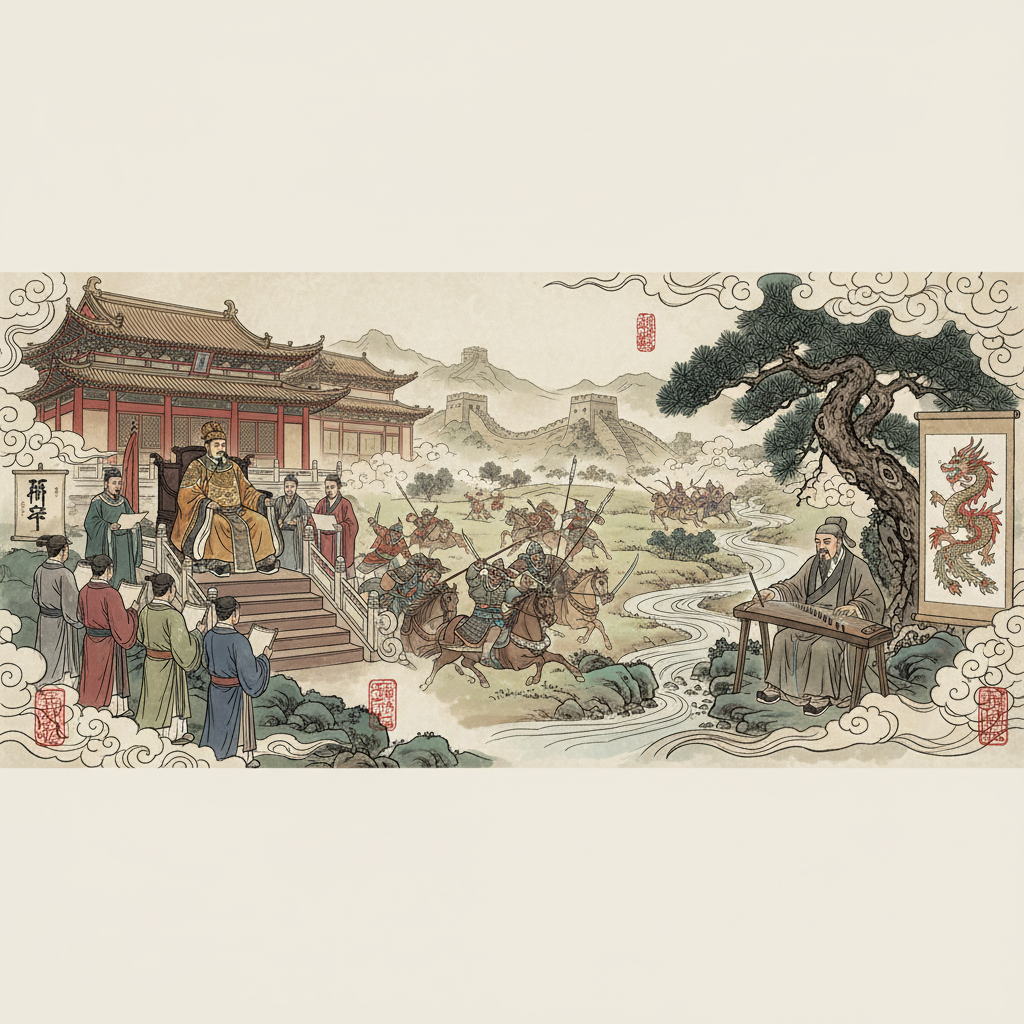
Introduction to Ancient Chinese History and Its Legal Foundations
Ancient China is renowned not only for its rich cultural heritage but also for the development of sophisticated legal systems that governed vast empires over millennia. From the earliest dynasties through the imperial eras, Chinese law evolved alongside battles for power, imperial decrees, and philosophical thought, shaping a civilization that laid the foundation for modern governance. This article explores the history of Chinese dynasties, their most pivotal emperors, landmark battles, and the cultural and legal innovations that defined ancient China’s enduring legacy.
The Rise of Dynasties and the Birth of Legal Codes
The earliest recognizable Chinese dynasty, the Shang (c. 1600–1046 BCE), set precedents in centralized authority and ritual law, though much of their legal system remains unclear due to limited records. The subsequent Zhou dynasty (1046–256 BCE) introduced the concept of the "Mandate of Heaven," a divine right to rule that tied legitimacy to moral governance and justice.
The Qin dynasty (221–206 BCE), despite its brief reign, was transformative in legal history. Emperor Qin Shi Huang unified warring states under a strict legalist philosophy promoted by Minister Li Si, codifying laws into a centralized system aimed at maintaining order and suppressing dissent. The infamous Qin Legal Code was brutal but effective, representing a watershed moment in Chinese legal history that influenced successor dynasties.
Emperors Who Shaped Law and Culture
Among China’s emperors, several stand out for their legal reforms and cultural patronage. Emperor Taizong of the Tang dynasty (r. 626–649 CE) established the Tang Code, one of the most sophisticated legal codes of its time, balancing punishments and moral standards. It profoundly influenced East Asian legal systems and remained in use for centuries.
Another key figure was Emperor Kangxi of the Qing dynasty (r. 1661–1722 CE), whose reign combined military conquests with reforms consolidating imperial control through codified regulations, promoting Confucian ideals and social stability. Kangxi's rule exemplified the synthesis of legal tradition and cultural flourishing, fostering a golden age of literature, art, and scholarship.
Pivotal Battles and Their Legal-Political Impact
Ancient China’s dynastic changes were often determined by epic conflicts that shook the legal and political landscape. The Battle of Red Cliffs (208 CE) during the late Han dynasty was decisive in dividing China into Three Kingdoms, leading to fragmented legal jurisdictions and evolving governance structures.
Similarly, the Mongol-led Yuan dynasty (1271–1368 CE) established after conquest imposed new legal features, integrating Mongol and Chinese law. This period witnessed the adaptation of existing codes to manage a multiethnic empire and trade along Eurasian routes, reflecting the practical need for flexible law in empire-building.
Cultural Contributions Rooted in Legal and Political Structures
Chinese culture is deeply intertwined with its legal institutions. Confucianism, which emphasized filial piety, social hierarchy, and moral governance, became the ideological backbone of imperial law and education systems. Legal examinations for bureaucracy recruitment promoted meritocracy, contributing to a stable administrative culture.
Arts and literature flourished under emperors who valued legal order as the foundation of societal harmony. For instance, the Song dynasty (960–1279 CE) produced exquisite calligraphy and poetry reflective of courtly ideals, supported by strict codes governing civil behavior and imperial etiquette.
Conclusion: The Enduring Legacy of Ancient Chinese Law and Culture
Ancient Chinese history reveals a continuous thread where law, battles, and culture are inseparable forces molding one of the world’s longest-lasting civilizations. The dynasties’ legal innovations, from Qin’s standardization to Tang’s codification, established governance models still studied today. The emperors’ roles in enforcing and refining these laws ensured political stability and cultural enrichment, setting a paradigm for future legal and cultural systems in China and beyond. Understanding this legacy offers critical insights into the foundational principles of Chinese society and its lasting influence globally.